Generac GB2000
- output
- 1,600 W
- surge
- 3,200 W
- weight
- 19.5 kg
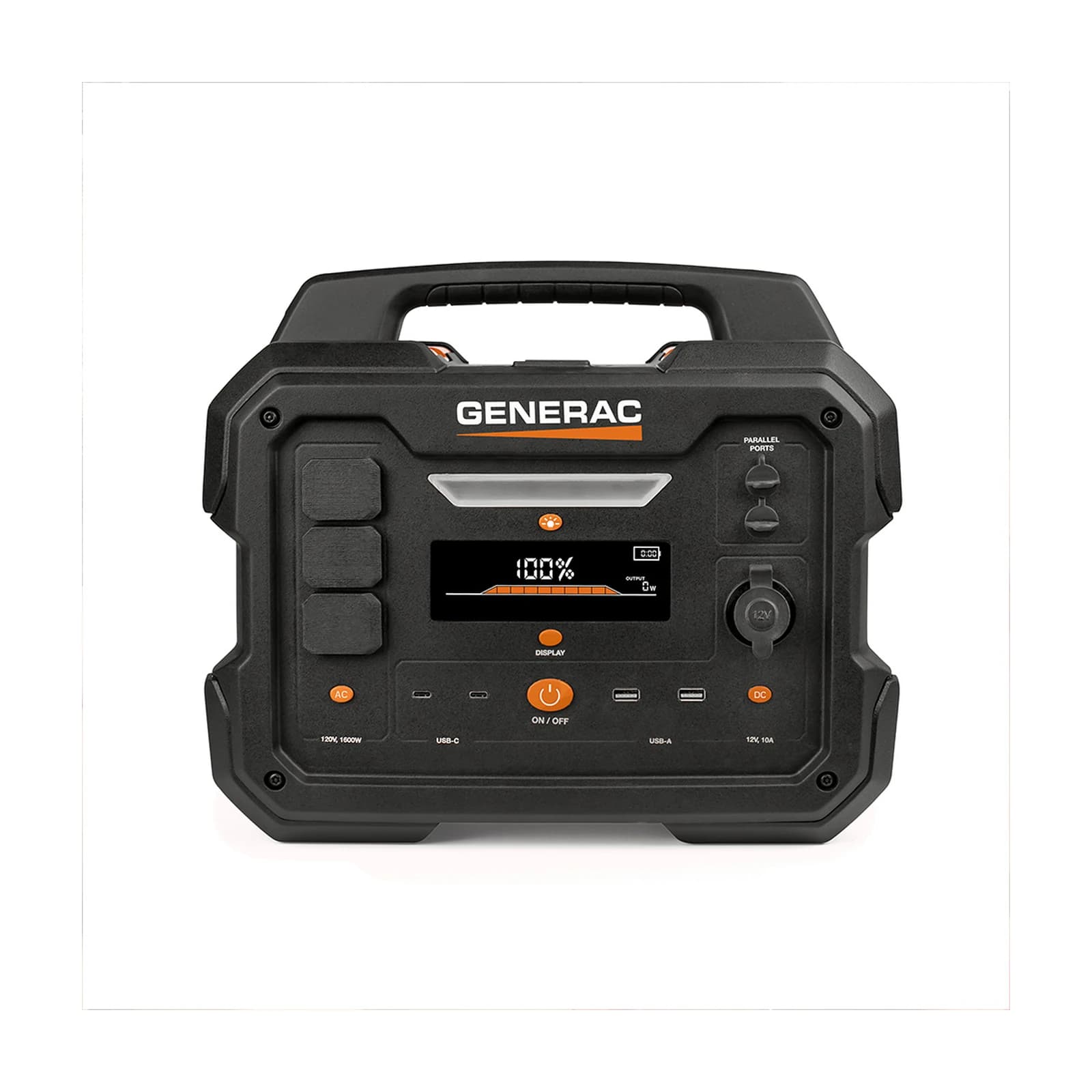
#15 of 15
in the Large (2 kWh class) class
Lifted by Portability and Output & versatility; held back by charging & solar.
No street price observed yet · $1,869 MSRP.
Capacity truth
The watt-hour number on the box isn't what reaches your devices. Same scale, three readings.
The marketing number — total cell capacity.
How it scores
Four buyer pillars over seven sub-scores — computed from sourced data with a published formula, price-independent by design.
Power
50% dataUsable capacity and how much you can run at once.
Usable watt-hours and how far you can grow it with add-on batteries, versus its size class.
Continuous and surge wattage, outlet count, and USB-C fast-charging.
Trust
42% dataOwner reputation, safety record, warranty, and build durability.
Owner ratings, brand reputation, recall record, and warranty backing.
Rated cycle life, warranty length, cell chemistry, and weather sealing.
Charging
est.Wall and solar recharge speed.
Wall recharge speed, solar input, and multi-source charging.
Livability
62% dataLightweight, portable, and quiet enough to live with.
Weight, footprint, handle, and wheels, versus its size class.
Fan noise under load — quieter is better for bedrooms and CPAP use.
How this score is computed
The BatteryRank score is computed from sourced data with a published formula — ranked by data, not lab testing. Seven sub-scores blend into a 0–100 composite, grouped into four buyer pillars. Price is deliberately not a scoring input: prices move daily, so value intelligence lives in the price section above, judged against this model's own history.
| Pillar | Built from | Weight |
|---|---|---|
| Power | Capacity & expansion + Output & versatility | 38% |
| Trust | Trust & reliability + Durability & longevity | 33% |
| Charging | Charging & solar | 16% |
| Livability | Portability + Quiet / livability | 13% |
Scores are cohort-relative — each model is ranked against others in its size class. Missing inputs renormalize out rather than scoring zero (a model is never penalized for a spec nobody in its class publishes), and any figure resting on a documented estimate is tagged est. A full methodology page is coming.
Full specifications
Manufacturer-claimed unless marked verified (FCC/UL/DOE/lab). Hover any figure for its source.
Capacity & battery
- Rated cycle life
- 1,000 cycles
- Battery chemistry
- NMC
- Rated capacity
- 2,106 Wh
- Cycle-life threshold
- 80 %
How many full charge-and-drain cycles before the battery drops to its rated threshold (shown alongside — brands rate to different thresholds, so never compare bare cycle counts).
The type of battery cell. LiFePO4 (LFP) cells last far more cycles and are more thermally stable than older lithium-ion (NMC) cells.
The battery's nameplate energy capacity — the headline number on the box. Real runtime comes from usable capacity and conversion losses, shown separately.
The remaining-capacity level the cycle rating is measured to. 3,000 cycles to 80% is a stronger battery than 3,000 cycles to 70% — always read the two numbers together.
Power output
- Continuous power output
- 1,600 W
- Surge power output
- 3,200 W
- AC outlets
- 3 outlets
- USB-A ports
- 2 ports
- USB-C ports
- 2 ports
- USB-C max output
- 65 W
The most power you can draw at once, sustained — this has to be higher than the running wattage of whatever you're plugging in.
A brief power spike the unit can absorb when a device first switches on — matters for things with motors or compressors, like fridges.
How many standard wall-style outlets are built in.
How many USB-A ports are built in, for charging older phones, lights, and accessories.
How many USB-C ports are built in — check the per-port wattage below if you need fast charging for a laptop.
The fastest a single USB-C port can charge a device — relevant for laptops and fast-charging phones.
Charging & solar
- AC recharge speed
- 450 W
- Max solar input
- 468 W
How fast the unit recharges from a wall outlet — higher means shorter waits between uses.
The most solar panel wattage the unit can accept — undersized panels just mean slower charging, not damage, but oversizing this is wasted money.
Size & portability
- Weight
- 19.5 kg
How much the unit weighs on its own, without accessories — relevant for portability and carrying it up stairs during an outage.
What reviewers & owners report
Aggregated from named outlets and marketplaces — we own no hardware and never fabricate impressions.
Brand reputation: Legacy US generator brand entering lithium stations; jobsite/rugged positioning, 15W wireless pad. Trustpilot 1.6/176 is very low (reflects Generac generator/support reputation broadly). Chemistry Li-ion not LFP - shorter cycle life expected.