LFP vs NMC
LFP lasts far longer and runs cooler and safer; NMC is lighter for the same energy. For most power-station buyers, LFP is the better default.
The cells inside the box decide how many years the station lasts, how much it weighs, and how safe it is sitting next to your bed. Two chemistries dominate — here's how to tell them apart and which fits your use.
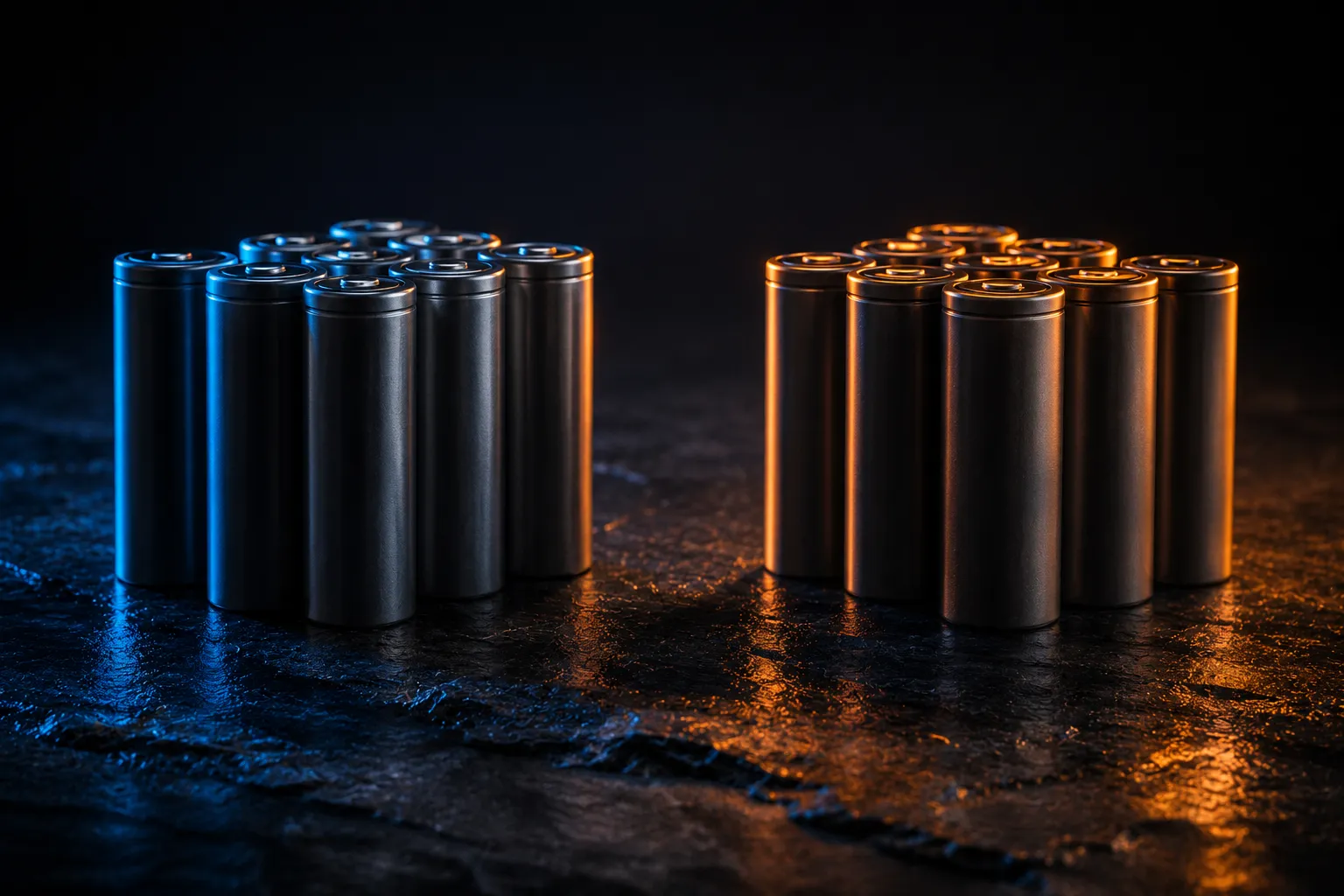
What the two chemistries actually are
LFP and NMC differ in the cathode — the part that stores and releases lithium ions. LFP uses stable iron phosphate; NMC uses a denser nickel-manganese-cobalt mix. That one material choice cascades into every practical difference: lifespan, weight, heat tolerance, and safety.
LFP (lithium iron phosphate, or LiFePO4) trades a little energy density for a lot of stability. Its cells stay chemically calm under heat and abuse, so they last thousands of cycles and are hard to push into a dangerous failure. NMC stores more energy in the same weight and volume — great for phones, laptops, and EVs where every gram matters — but it’s more reactive and wears out faster. Neither is “bad”; they’re optimized for different priorities.
Cycle life: the number that decides longevity
A charge cycle is one full charge-and-discharge. LFP is typically rated for 3,000–5,000+ cycles before it fades to 80% of its original capacity; NMC is usually 500–1,000. That gap is the single biggest reason to prefer LFP in a station you plan to keep.
Put it in calendar terms. An LFP station rated for 3,000 cycles, cycled once a week, would take over 50 years to reach that 80% mark — the electronics fail first. The same duty on an NMC pack rated for 800 cycles is more like 15 years. And “80% capacity” isn’t death — the station keeps working, it just holds less. Rated cycle life is one of the sourced inputs to a station’s Trust pillar in our score.
Weight, safety, and heat
NMC is lighter for the same watt-hours; LFP is safer and more heat-tolerant. If the station lives indoors, gets carried in a hot car, or sits by your bed, LFP’s stability is worth more than NMC’s weight savings.
NMC’s higher energy density means a lighter box for the same capacity — a real advantage if you’re backpacking or squeezing a battery into a camper build. But LFP has a higher thermal-runaway threshold and releases far less energy if a cell fails, which is why it dominates home-backup and medical use. Both chemistries dislike charging below freezing without a built-in heater, and both lose some usable capacity in the cold.
| LFP (LiFePO4) | NMC | |
|---|---|---|
| Cycle life (to 80%) | 3,000–5,000+ | 500–1,000 |
| Energy density | Lower (heavier) | Higher (lighter) |
| Thermal safety | Excellent — resists runaway | Good with BMS, less forgiving |
| Best for | Home backup, van life, CPAP | Ultralight / space-constrained builds |
| Typical today | Most quality stations | Older or budget-lightweight units |
Which should you buy?
Choose LFP unless minimizing weight is your top priority. For the vast majority of power-station uses — outages, camping, RVs, CPAP — LFP’s decade-plus lifespan and bedside safety outweigh the extra pound or two.
LFP is the right call if you
- Want a station that lasts 10+ years of regular use
- Keep it indoors or run it next to where you sleep (CPAP, home backup)
- Leave it in a hot garage, car, or RV
- Care most about safety and total cost per year
NMC can make sense if you
- Carry the station on your back and count every gram
- Need maximum capacity in a very tight space
- Cycle it lightly, so cycle life is less of a factor
- Accept a shorter lifespan for the weight savings
On any model page we mark battery chemistry as a sourced spec — claimed by the manufacturer unless a lab or certification verifies it — so you never have to guess which chemistry you’re actually buying.
Frequently asked questions
- Is LFP or NMC better for a power station?
- For most buyers, LFP. It typically lasts 3,000–5,000+ charge cycles versus roughly 500–1,000 for NMC, tolerates heat far better, and is much less prone to thermal runaway. NMC's advantage is energy density — more watt-hours in less weight and space — which matters most when you're carrying the station on your back or fitting it into a tight build. For home backup, van life, and CPAP use, LFP's longevity and safety usually win.
- What does LFP stand for?
- LFP is lithium iron phosphate, also written LiFePO4. The 'iron phosphate' cathode is chemically very stable, which is why LFP cells resist overheating and last thousands of cycles. NMC is nickel manganese cobalt, a denser cathode chemistry that stores more energy per kilogram but is less thermally stable and wears out sooner.
- How many years will an LFP power station last?
- If LFP is rated for 3,000 cycles to 80% capacity and you fully cycle it once a week, that's roughly 57 years of cycles — you'll replace it for other reasons first. Even cycling daily, 3,000 cycles is about 8 years before it drops to 80% of its original capacity (and it still works after that, just with less runtime). NMC at ~500–1,000 cycles reaches that point far sooner under the same use.
- Is LFP safer than NMC?
- Generally yes. LFP has a higher thermal-runaway threshold and releases less energy if it does fail, which is why it's favored where a station sits indoors or next to where people sleep. NMC can still be safe — reputable brands add battery-management protection — but the chemistry itself is more energy-dense and less forgiving of abuse, heat, or damage.
- Does cold weather affect LFP and NMC differently?
- Both lithium chemistries lose usable capacity in the cold and should not be charged below freezing without a heater. NMC holds a slight edge in low-temperature performance, but the difference is small next to LFP's cycle-life and safety advantages. In genuinely cold use, look for a station with built-in low-temperature charge protection regardless of chemistry.