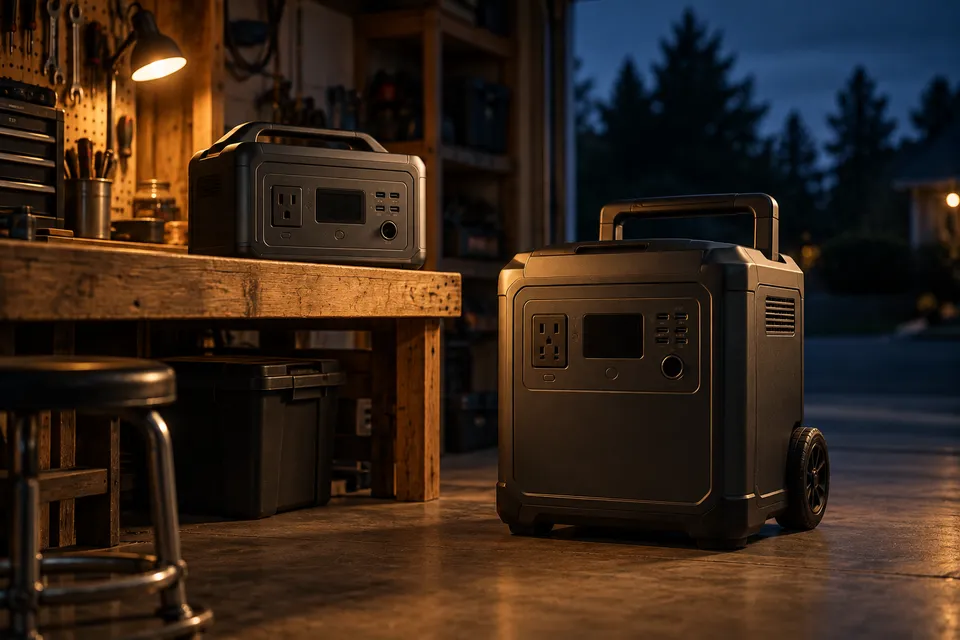
What the extra capacity buys
At the same load and efficiency, twice the stored energy gives twice the estimated runtime. That can cover a longer outage or remove a recharge stop. Check the complete station’s weight and dimensions before paying for capacity you will rarely use.
Before you size up
Sizing for a list of appliances without deciding how long they need power. A fridge cycles on its own thermostat; use its measured daily energy instead of planning a manual on/off schedule. Then include lights, networking and other loads over the same duration.
The capacity difference in practical terms
For the same constant load, more usable energy means more runtime. This table multiplies rated capacity by our published AC-efficiency assumption, then divides by watts.
| Rated size | Estimated usable AC energy | At 100 W | At 500 W |
|---|---|---|---|
| 1,000Wh | 850 Whest.. Show sourceestimated sourcebatteryrank.com2026-07-16https://batteryrank.com/methodology | 8.5 hoursest.. Show sourceestimated sourcebatteryrank.com2026-07-16https://batteryrank.com/methodology | 1.7 hoursest.. Show sourceestimated sourcebatteryrank.com2026-07-16https://batteryrank.com/methodology |
| 2,000Wh | 1700 Whest.. Show sourceestimated sourcebatteryrank.com2026-07-16https://batteryrank.com/methodology | 17 hoursest.. Show sourceestimated sourcebatteryrank.com2026-07-16https://batteryrank.com/methodology | 3.4 hoursest.. Show sourceestimated sourcebatteryrank.com2026-07-16https://batteryrank.com/methodology |
These are planning estimates, not product tests. Device duty cycle, startup surge, temperature, battery age, and conversion path can change actual runtime.
What these estimates do not cover
The table uses a constant load and a published efficiency assumption. It does not predict your outage length, fridge cycling or charging opportunities. Weight also needs context: check dimensions, handles and where you will put the station, not only its mass.
When each size makes sense
Choose about 1,000Wh
- Your calculated load fits with reserve
- Carry size matters more than maximum duration
- You can recharge between use periods
Choose about 2,000Wh
- The smaller estimate misses your required duration
- You have included reserve for essential loads
- You need more reserve between recharges
Compare actual stations
Compare the actual models in each size class. Check output, weight and delivered capacity alongside the current price.
Frequently asked questions
- How much usable AC energy does a 1000Wh station provide?
- Using BatteryRank’s published default AC-efficiency assumption, the planning estimate is about 850Wh. A measured model-specific result overrides this estimate when available.
- How much usable AC energy does a 2000Wh station provide?
- Using the same planning assumption, the estimate is about 1700Wh. Real results vary by load, chemistry, inverter, temperature, and station.
- Is 2,000 Wh enough to get through a multi-day outage?
- It depends on measured daily consumption and any charging during the outage. Add the required energy for all essential loads over the planned days, then compare it with delivered capacity and reserve. The size label alone cannot promise several days of refrigeration.
- Should I buy 2,000 Wh now or a 1,000 Wh unit I can expand later?
- Compare current prices for the complete setups, the supported expansion limits and the space you have. An extra battery can add storage, but check whether the system’s output changes. Choose around the duration you need now and the expansion you are likely to use.