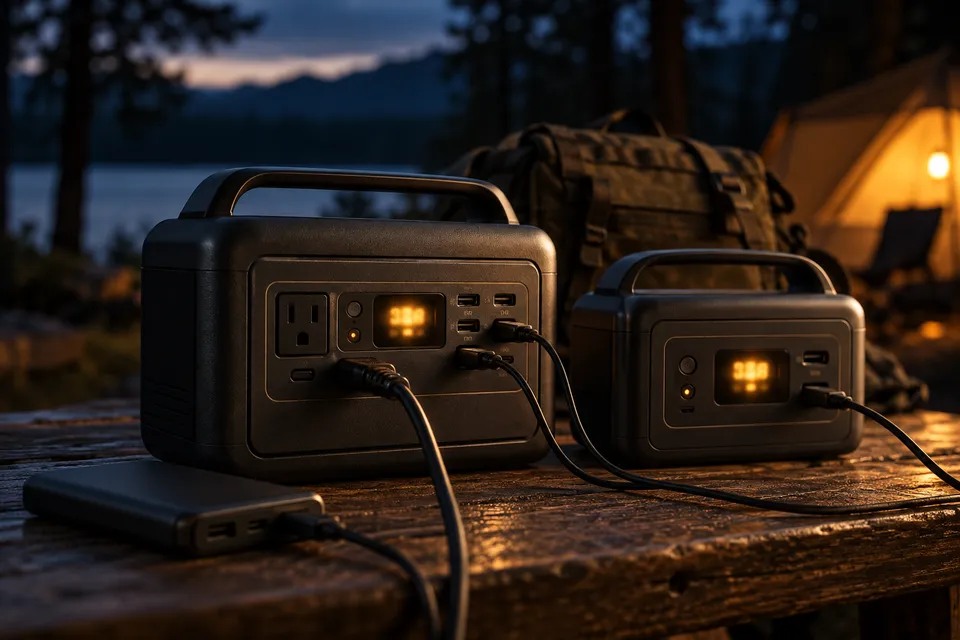
What the extra capacity buys
Doubling the capacity can buy more time between charges. If the smaller station already powers your devices, the decision is whether that extra time is worth the weight and cost. If it cannot start an appliance, check output first: a larger battery alone will not fix that.
Before you size up
Buying a 1,000 Wh station to run a fridge without checking its inverter. The continuous output must cover the running load, and the supported surge rating and duration must fit startup. Read those specifications on the actual model, then calculate runtime.
The capacity difference in practical terms
For the same constant load, more usable energy means more runtime. This table multiplies rated capacity by our published AC-efficiency assumption, then divides by watts.
| Rated size | Estimated usable AC energy | At 100 W | At 500 W |
|---|---|---|---|
| 500Wh | 425 Whest.. Show sourceestimated sourcebatteryrank.com2026-07-16https://batteryrank.com/methodology | 4.3 hoursest.. Show sourceestimated sourcebatteryrank.com2026-07-16https://batteryrank.com/methodology | 0.9 hoursest.. Show sourceestimated sourcebatteryrank.com2026-07-16https://batteryrank.com/methodology |
| 1,000Wh | 850 Whest.. Show sourceestimated sourcebatteryrank.com2026-07-16https://batteryrank.com/methodology | 8.5 hoursest.. Show sourceestimated sourcebatteryrank.com2026-07-16https://batteryrank.com/methodology | 1.7 hoursest.. Show sourceestimated sourcebatteryrank.com2026-07-16https://batteryrank.com/methodology |
These are planning estimates, not product tests. Device duty cycle, startup surge, temperature, battery age, and conversion path can change actual runtime.
What these estimates do not cover
The table applies our published efficiency assumption to rated capacity. It estimates energy for a constant load. Use a model’s measured or estimated AC-delivered capacity when available, and your fridge’s average draw rather than its running watts alone.
When each size makes sense
Choose about 500Wh
- Your calculated load fits with reserve
- Carry size matters more than maximum duration
- You can recharge between use periods
Choose about 1,000Wh
- The smaller estimate misses your required duration
- You have included reserve for essential loads
- You need more reserve between recharges
Compare actual stations
Compare the actual models in each size class. Check output, weight and delivered capacity alongside the current price.
Frequently asked questions
- How much usable AC energy does a 500Wh station provide?
- Using BatteryRank’s published default AC-efficiency assumption, the planning estimate is about 425Wh. A measured model-specific result overrides this estimate when available.
- How much usable AC energy does a 1000Wh station provide?
- Using the same planning assumption, the estimate is about 850Wh. Real results vary by load, chemistry, inverter, temperature, and station.
- Will a 1,000 Wh station run a refrigerator when a 500 Wh one will not?
- Capacity alone cannot answer that. Compare each station’s continuous output and supported startup surge with the fridge’s requirements. If both pass those checks, the larger delivered-energy figure can provide longer runtime at the same average load.
- Is one 1,000 Wh station better than two 500 Wh ones?
- One larger station may be easier to manage for a single appliance, while two separate units can support gear in different places. Do not connect their AC outputs together. Check the exact manufacturer-supported expansion options rather than adding their inverter ratings.