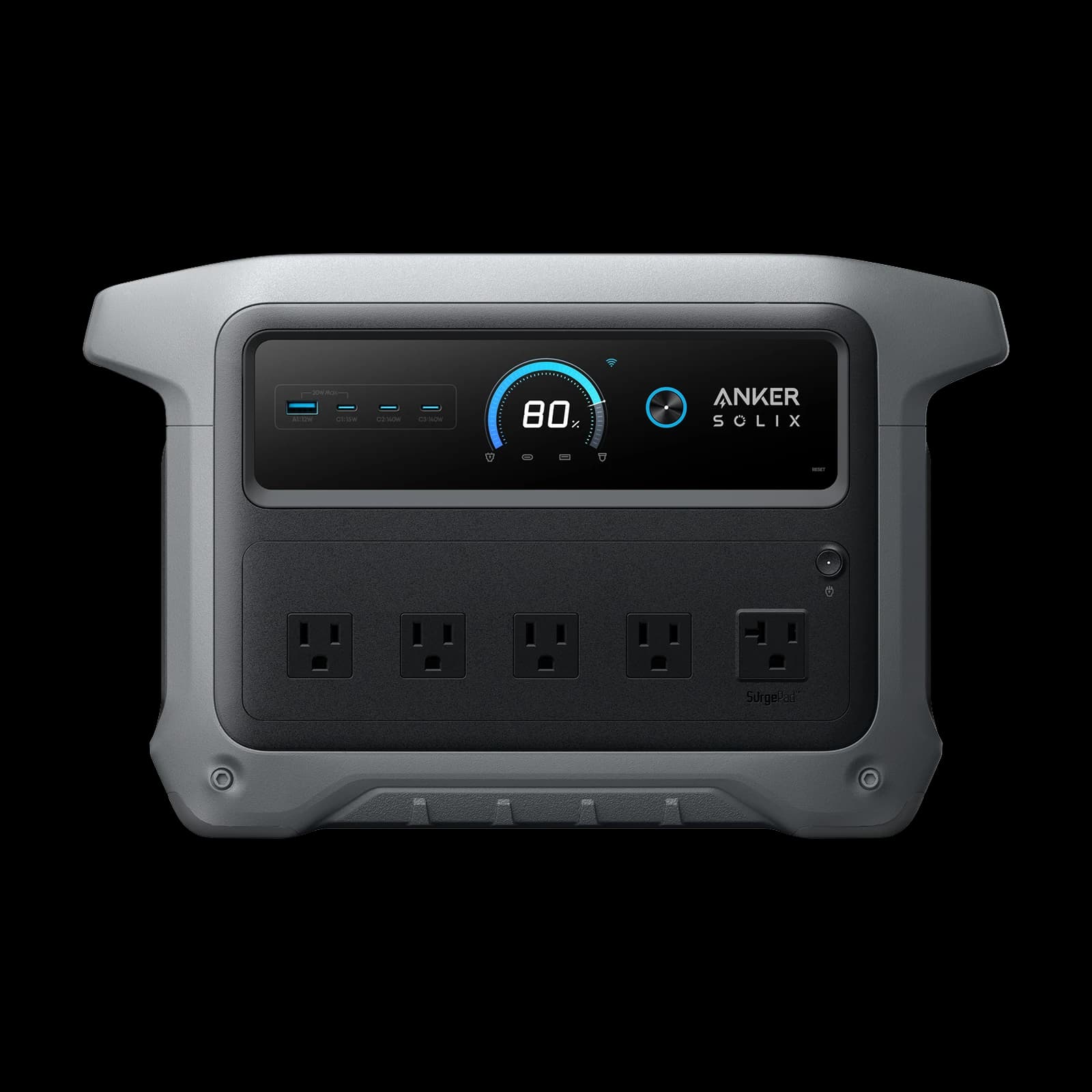
Anker SOLIX C1000 Gen 2
68BatteryRank score · Balanced
Bluetti AC180 takes capacity and output, Anker SOLIX C1000 Gen 2 takes weight and noise — the decision is which of those you need, not overall quality. If neither is your constraint, the composite tiebreak goes to Anker SOLIX C1000 Gen 2 by 5 points — a hair, not a mandate.
By the BatteryRank Engineering Team
Our buying analysis
We would begin with the move from the storage shelf to the appliance or car. The C1000 Gen 2 has a lighter base unit and a smaller rated pack; the AC180 has more base energy in a heavier enclosure. A battery used frequently away from home makes that difference part of every outing. A battery left beside selected outage loads makes the interval before recharging more central.
Anker also has the higher continuous-output and USB-C port ceilings in our sourced records. BLUETTI’s larger battery may be useful when modest loads must run longer between refills, but capacity alone does not establish delivered runtime. The AC180’s supported power-bank connection is an external charging arrangement, which needs its own cable and operating-mode checks; we would not treat it as an unrestricted extension of inverter power. The C1000 Gen 2 remains a fixed-pack station.
Keep AC180 separate from AC180P, and C1000 Gen 2 separate from the original expandable C1000. BLUETTI advertises a partial-charge endpoint on its AC180 page, so do not compare that directly with Anker’s full-charge claim. For mixed appliances, work within continuous output and keep Power Lifting separate from motor-start evidence. We would also verify the exact USB-C charging profile if laptop use is central, rather than assume every port with that connector can deliver the same power.
Sources reviewed : Anker SOLIX US — C1000 Gen 2; BLUETTI US — AC180 and power-bank connection.
Follow the evidence in the specification table below, or read our Anker SOLIX C1000 Gen 2 review and Bluetti AC180 review.
Where to buy
Affiliate links: we may earn a commission if you buy, at no extra cost to you. Commission never affects our rankings.
Anker SOLIX C1000 Gen 2
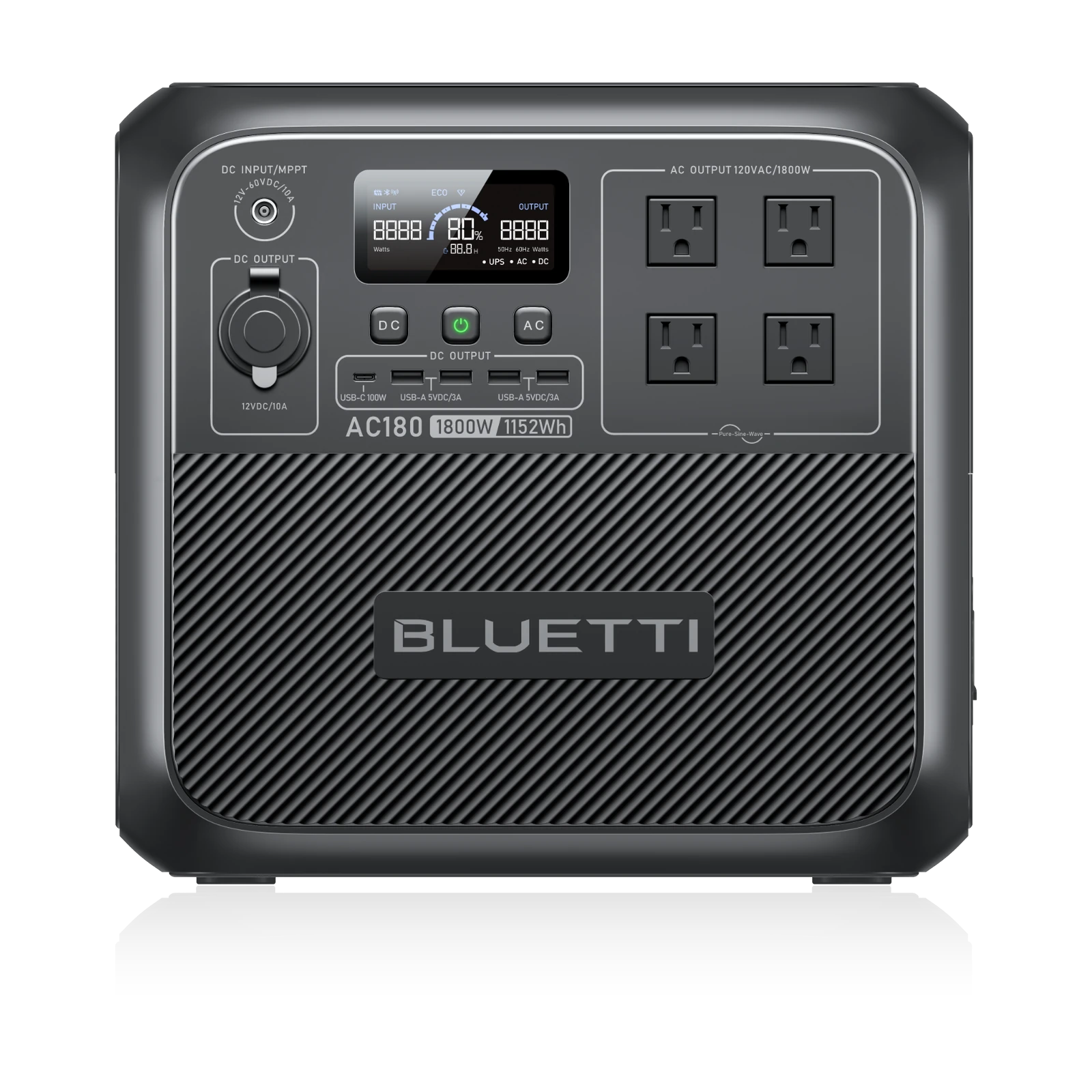
Bluetti AC180
Battery-side usable capacity and how much you can run at once.
Owner reputation, safety record, warranty, and build durability.
Wall and solar recharge speed.
Lightweight, portable, and quiet enough to live with.
Computed from sourced data with a published, price-independent formula. Scores are relative to each model's size class.
The watt-hours on the box aren't what reaches your devices. Same scale, both units.
The marketing number — total cell capacity.
What reaches an AC outlet — about 15% is lost turning battery power into household AC. How we estimate.
The marketing number — total cell capacity.
~950 Wh (OutdoorGearLab) · 18% below the label
| Device | Anker SOLIX C1000 Gen 2 | Bluetti AC180 | Assumption |
|---|---|---|---|
| CPAP (humidifier off) | about 12.1 nights | about 13.2 nights | 9 W · |
| CPAP (heated humidifier on) | about 1.9 nights | about 2.1 nights | 56 W · |
| Refrigerator (full-size) | about 14 hours | about 15 hours | 180 W × 35% duty cycle · |
| Wi-Fi router + modem | about 48 hours | about 53 hours | 18 W · |
| Laptop (65W charger) | about 27 hours | about 29 hours | 65 W × 50% duty cycle · |
| Phone (one full charge) | about 43 full charges | about 47 full charges | 20 W · |
One device at a time; estimates use each station's usable AC energy. Build your own load →
| Spec | Anker SOLIX C1000 Gen 2 | Bluetti AC180 |
|---|---|---|
| AC-delivered capacity | 870 Whest.. Show sourceestimated sourceankersolix.com ↗2026-07-04 | 950 Whverified. Show sourceverified source~950 Wh (OutdoorGearLab)2026-07-04 |
| Continuous power output | 2,000 W. Show sourceclaimed sourceankersolix.com ↗2026-07-04 | 1,800 W. Show sourceclaimed sourcebluettipower.com ↗2026-07-04 |
| Surge power output | 3,000 W. Show sourceclaimed sourceankersolix.com ↗2026-07-04 | 2,700 W. Show sourceclaimed sourcebluettipower.com ↗2026-07-04 |
| Max solar input | 600 W. Show sourceclaimed sourceankersolix.com ↗2026-07-04 | 500 W. Show sourceclaimed sourcebluettipower.com ↗2026-07-04 |
| AC charge time (0–100%) | 49 min. Show sourceclaimed sourceankersolix.com ↗2026-07-04 | — |
| Weight | 11.3 kg. Show sourceclaimed sourceankersolix.com ↗2026-07-04 | 16 kg. Show sourceclaimed sourcebluettipower.com ↗2026-07-04 |
| Rated cycle life | 4,000 cycles. Show sourceclaimed sourceankersolix.com ↗2026-07-04 | 3,500 cycles. Show sourceclaimed sourcebluettipower.com ↗2026-07-04 |
Manufacturer figures unless marked verified or est. Tap or focus a figure to view its source. The better reading in each row is highlighted — lower wins for weight and recharge time.