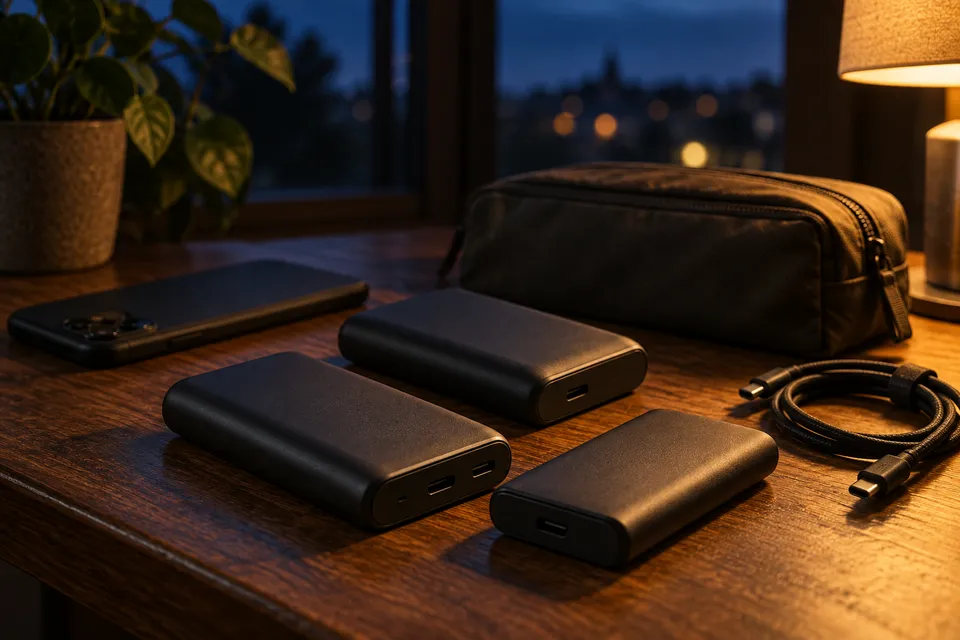
What will you charge?
Write down the exact device model, its connector and the charging rate its maker recommends. Note whether you will charge a second device at the same time. For a laptop, confirm that its USB-C port supports charging.
Decide what you want to carry. More capacity can add weight; an attached cable saves a loose lead; magnetic charging can suit a compatible phone. If a cable-free phone setup matters, compare the device and bank’s wireless standards.
Compare capacity and single-port output
INIU lists the Carry P55L-E2 at 10,000 mAh. One USB-C output reaches 45 W.
Source: manufacturer specifications, checked October 7, 2026.
UGREEN lists its Nexode at 20,000 mAh. USB-C1 reaches 100 W; its 165 W rating applies across outputs.
Source: manufacturer specifications, checked October 7, 2026.
Use explicit Wh ratings to compare stored energy. Do not convert mAh without a sourced voltage. The mAh-to-Wh guide explains the relationship.
Compare capacity with carry weight
| Model | Capacity | Single-port output | Weight |
|---|---|---|---|
| INIU Carry P55L-E2 | 10,000 mAh | 45 W | 180.4 g |
| UGREEN Nexode with retractable cable | 20,000 mAh | 100 W | 535 g |
The INIU’s attached lead and the UGREEN’s retractable cable reduce the number of separate cables to pack. Each cable has its own output limit, listed on the model page.
Check the fit before you buy
- Confirm the device supports the bank’s connection and charging protocol.
- Match one port’s output to the device maker’s recommended input.
- Compare published Wh ratings; do not infer Wh from mAh alone.
- Check the weight of the bank and any separate cable or adapter.
- Check bank input if recharge time matters.
- Read the shared-output table if you will charge several devices.
Choose the lightest bank that meets your capacity and charging needs. Make sure the port and cable fit your device, and the weight fits your routine.
Frequently asked questions
- Are larger mAh labels always proportionally better?
- They are comparable only when both labels use the same cell voltage. Compare manufacturer-rated watt-hours when both products publish them; never infer Wh from mAh without a sourced voltage. See our mAh-to-Wh guide for the conversion and its limits.
- How many watts should my power bank have?
- Start with the device maker’s recommended adapter wattage and supported charging input. Then compare that with the bank’s maximum from one port, not its combined-output headline. A lower output may charge more slowly or behave differently under load.
- Should I choose a power bank with a built-in cable?
- Choose one when the cable type, length and rated output fit your devices and you value having one fewer loose item. A fixed cable is not interchangeable, so check the bank’s separate ports and cable rating before buying.