Start with the actual Wh label
Watt-hours, written Wh, describe stored energy. The W rating describes output power. A bank that advertises high-watt USB-C charging can still have a relatively small battery. The output number does not establish its baggage category.
Use the manufacturer’s explicit Wh rating when available. If conversion is necessary:
Wh = mAh × the voltage used for that capacity rating ÷ 1,000.
Do not automatically multiply by the USB output voltage or assume every bank uses the same cell voltage. Read our mAh-to-Wh guide. The FAA battery guidance explains the energy calculation. Reviewed October 10, 2026.
What size is allowed?
The current US FAA baseline distinguishes batteries at or below 100Wh, larger batteries up to 160Wh with airline approval, and batteries above that range. Airlines and international rules can be stricter.
| Marked energy | US FAA passenger-baggage baseline for a spare lithium-ion bank | What you need to verify |
|---|---|---|
| At or below 100Wh | Carry-on only | Carrier quantity limits, route rules and device condition. |
| Above 100Wh, at or below 160Wh | Airline approval. At most two larger spare batteries | Whether the airline accepts power banks in this range. General spare-battery permission is not enough. |
| Above 160Wh | Not permitted as ordinary passenger baggage | Putting it in a different bag does not change its battery rating. |
Source: FAA airline passengers and batteries, updated October 2, 2026. Rechecked October 12, 2026.
What changed internationally in 2026?
ICAO’s amendment effective March 27, 2026 limits passengers to two power banks and prohibits recharging the banks during flight. The amendment also recommends against using them to charge personal electronic devices. That recommendation and a carrier’s mandatory use ban are different things. ICAO announcement, reviewed October 10, 2026.
The current US FAA page does not show the same universal two-bank limit in its under-100Wh baseline. IATA explains that enforceability depends on how states adopt the international instructions. For a trip that crosses jurisdictions, we would pack no more than two and check every operating carrier’s current policy. IATA operator guidance, March 31, 2026, reviewed October 10, 2026.
Airline rules can change the answer
These examples show why a general size chart cannot approve a trip.
| Operating airline | Capacity and quantity | Use and storage |
|---|---|---|
| Delta Air Lines | Maximum two banks, each at or below 100Wh. Its power-bank rule gives no larger-bank exception. | No recharging the bank onboard. No using it to recharge a device during taxi, takeoff or landing. Keep it accessible, outside the overhead bin. |
| Singapore Airlines | Maximum two. At or below 100Wh without approval, above 100Wh up to 160Wh with approval. | No recharging the bank or using it to charge devices throughout the flight. Keep it accessible in a seat pocket or under the seat, outside the overhead bin. |
Sources: Delta battery policy, Singapore Airlines safety FAQ and Singapore Airlines advisory effective April 15, 2026, Delta and Singapore Airlines FAQ rechecked October 12, 2026. The advisory was reviewed October 10, 2026. These examples do not set other carriers’ policies.
Check the airline operating the aircraft, including connecting flights. Save any required approval and leave time to resolve conflicting guidance before travel.
China domestic flights: check the CCC mark and recalls
CAAC’s notice effective June 28, 2025 prohibits power banks without a clear CCC mark, or belonging to recalled models or batches, on domestic flights. A low Wh rating alone therefore cannot establish acceptance for a China domestic leg. CAAC English notice, reviewed October 10, 2026.
That notice’s stated scope is domestic flights. It should not be rewritten as a universal CCC requirement for every international journey. If you connect to a domestic flight, check the bank you will actually carry and the carrier’s policy. A US-market example below is not a verified CCC-qualified recommendation.
Real product examples: compare energy before buying
We use explicit manufacturer energy ratings, rather than inferring them from an mAh headline. These candidates fit different device kits. The table checks energy against a common airline threshold. It does not promise acceptance on every route or establish a safety ranking.
| Exact model | Manufacturer-rated energy | Our buying interpretation |
|---|---|---|
| Anker Nano A1638 | 36Wh | A compact phone-oriented option with a built-in cable. Comfortably below 100Wh. |
| NITECORE NB10000 Gen4 | 39Wh | A phone-oriented outdoor carry option. Comfortably below 100Wh. |
| Anker Prime A110A | 99.75Wh | A laptop-oriented option close to the threshold. Confirm the readable marking on the actual unit and the airline’s policy. |
Manufacturer evidence, reviewed October 10, 2026: Anker A1638 FAQ, NITECORE product page and Anker A110A support page. Model numbers identify revisions, not additional capacity readings.
For laptop charging, compare the laptop’s required USB-C profile and the bank’s single-port output in our compatibility guide. A shared output headline is not the output available to one laptop.
If you buy through our affiliate links, we may earn a commission at no extra cost to you. The manufacturer links above provide evidence. They do not substitute for the airline’s rules.
Can you fly with a portable power station?
Many household and camping stations exceed passenger-baggage battery limits. For example, EcoFlow’s DELTA 3 Plus is rated 1,024Wh, and Jackery’s Explorer 1000 v2 is rated 1,070Wh. Both are far above the FAA’s 160Wh ordinary passenger-baggage ceiling. Neither moving them into checked baggage nor discharging them changes their rated energy.
Sources: EcoFlow exact-model manual, Jackery exact-model support and FAA PackSafe, reviewed October 10, 2026.
A smaller product marketed as a “power station” still needs classification and airline review. A carrying handle or AC socket does not decide its battery allowance. If your destination needs household-scale backup, arrange a suitable unit there. Shipping lithium batteries is a separate dangerous-goods process.
Pack it so the crew can reach it
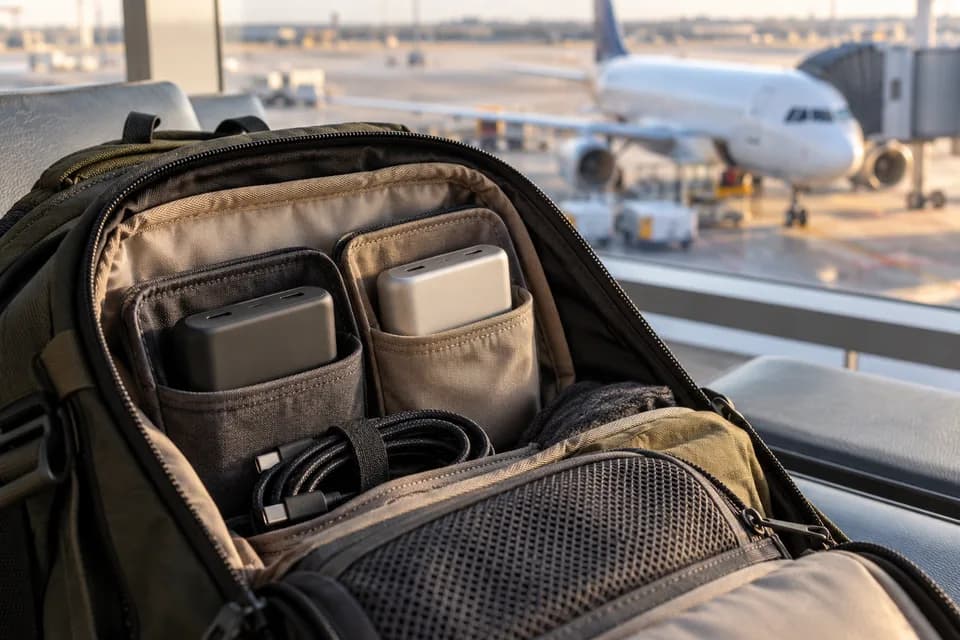
Keep banks in cabin baggage, protect them from short circuits and crushing, and follow the carrier’s accessibility and storage instructions. If your carry-on is checked at the gate, remove the power banks first. Do not fly with damaged, defective or recalled batteries. If one becomes hot, emits smoke or is trapped in a seat, tell the crew immediately rather than attempting to retrieve or repair it yourself. FAA lithium-battery guidance, reviewed October 10, 2026. Read our thermal-runaway guide for damage and warning signs.
What is announced for 2027?
IATA’s March 2026 operator guidance says that the allowance for power banks above 100Wh up to 160Wh with operator approval will not carry into its 68th edition, effective January 1, 2027. This is a future edition change as of this article’s research date. It is not a reason to rewrite every 2026 airline policy as already capped at 100Wh. Recheck the applicable edition and carrier policy for a 2027 journey. IATA operator guidance, reviewed October 10, 2026.
Frequently asked questions
- Is a 20,000mAh bank allowed?
- The mAh label alone is insufficient. Read its actual Wh marking, then check the airline, quantity limits and route rules. The manufacturer’s voltage basis matters if you need to calculate energy.
- Can I take a 30,000mAh bank with airline approval?
- Do not infer permission from that label. Establish the exact Wh rating first. Some airlines prohibit every power bank above 100Wh, even though the 2026 general approval pathway can cover larger spare batteries. Check the travel date as well.
- Can a compliant bank go in checked baggage?
- No. A power bank is treated as a spare battery and belongs in carry-on baggage. This also matters when a cabin bag is checked at the gate.
- Can I charge my phone with it during the flight?
- Only if the operating airline’s current policy permits that use. Carrying permission is separate. Singapore Airlines prohibits bank use throughout the flight. Delta explicitly restricts it during taxi, takeoff and landing.
- Does an “airline approved” product listing settle it?
- No. You still need the actual energy label, device condition and the airline’s rules for your route. Manufacturer marketing cannot approve a connecting flight or establish the required regional marking.