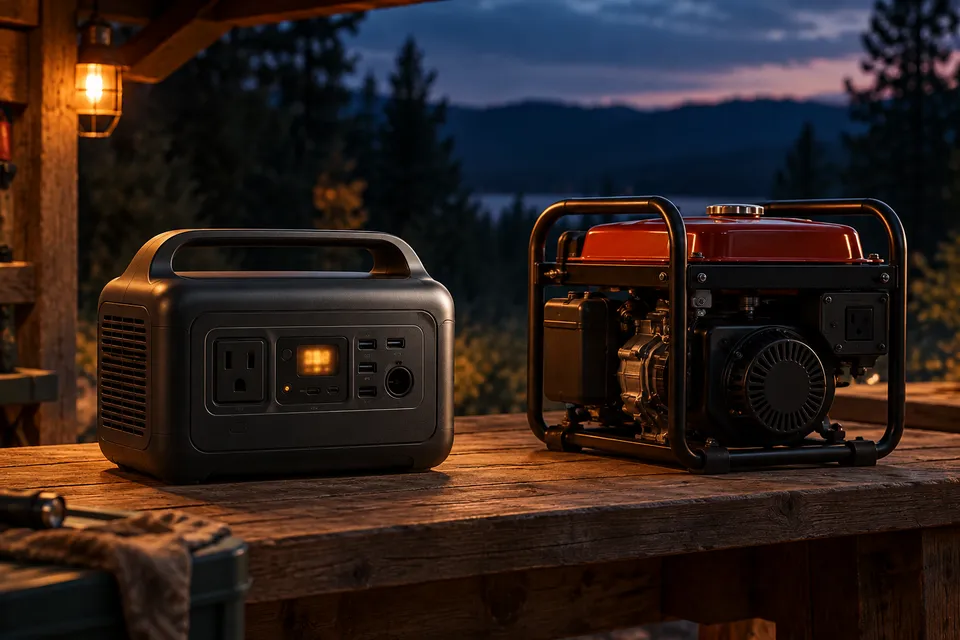
Where each option fits
A generator converts fuel to electricity, with operation limited by fuel, its duty instructions and maintenance. A power station stores electricity and needs recharging after that energy is used. Battery operation avoids engine noise, although cooling fans can still be audible.
Reasons to consider a battery
- No combustion exhaust, with placement and ventilation per the manual
- No engine noise, though cooling fans may run
- No fuel to buy, store, or go stale; no oil changes
- Charging from the grid or a compatible solar array
Reasons to consider a generator
- Multi-day outages with no way to recharge a battery
- Heavy loads, when the generator’s output and startup ratings fit
- Compare current equipment cost alongside fuel and maintenance
- Fuel can replenish supply, with shutdown and cooling before refueling
Placement and refueling: CPSC generator guidance requires outdoor use away from buildings and turning the generator off and letting it cool before refueling. Reviewed October 8, 2026.
How much a power station actually covers
These three stations illustrate different backup capacities and outputs. Each linked model page carries the source and date for its figures. Check your appliance inputs and startup demand before comparing runtime.
| Model | AC-delivered capacity | AC inverter | Chemistry |
|---|---|---|---|
| Bluetti AC200L | 1,835 Wh | 2,400 W | LFP |
| EcoFlow DELTA Pro 3 | 3,790 Wh | 4,000 W | LFP |
| Anker SOLIX F3800 | 3,264 Wh | 6,000 W | LFP |
Whether one of these models covers your outage depends on the appliances, their startup requirements and the duration. Use the sourced capacity and output readings to check your plan. Browse our best for home backup ranking.
Choose around the outage you need to cover
Start with a battery when its output and delivered energy cover your essentials and you have a realistic recharge plan. Consider a fuel generator when the load or duration exceeds that plan and you can meet its outdoor operating requirements.
Write down how you will recharge or refuel before the initial supply runs out. Solar adds another source of charging, but a panel’s nameplate is not a promise of daily harvest. A generator-and-battery setup also needs manufacturer-supported charging connections and separate placement checks.
Frequently asked questions
- Is a power station better than a generator?
- Choose around the loads, location, required duration and replenishment plan. A battery avoids combustion exhaust and can support essentials within its output and stored-energy limits. A fuel generator may suit longer heavy-load operation when fuel and a suitable outdoor location are available.
- Can you run a power station indoors?
- A battery station produces no combustion exhaust. Follow its manual for ventilation, temperature, clearance and electrical connections. A fuel generator must operate outdoors, away from the home and openings, as directed by CPSC; never use it indoors or in a garage.
- How long can a power station run compared to a generator?
- A battery’s runtime depends on delivered energy and the load, then it needs recharging. A generator depends on fuel, its duty limits and maintenance, with shutdown and cooling before refueling. Neither gives an unlimited unattended supply.
- Are solar generators just power stations?
- The term commonly describes a solar-capable battery station, often sold with panels. Check the listing: panel inclusion, cables and electrical compatibility vary. Solar harvest also depends on site, season and weather.
- Which is cheaper, a power station or a generator?
- Compare current equipment prices, required accessories and the energy or fuel you expect to use. Charging electricity, fuel, maintenance and replacement all belong in the comparison. There is no universal cost winner for every load and outage pattern.