EcoFlow DELTA Pro 3
- AC delivered · measured
3,790 Wh. Show source
verified source3790Wh usable at >93% efficiency (OutdoorGearLab) vs 4096 rated2026-07-04- output
4,000 W. Show source
claimed sourceus.ecoflow.com ↗2026-07-04- surge
8,000 W. Show source
claimed sourceus.ecoflow.com ↗2026-07-04- weight
51.5 kg. Show source
claimed sourceus.ecoflow.com ↗2026-07-04
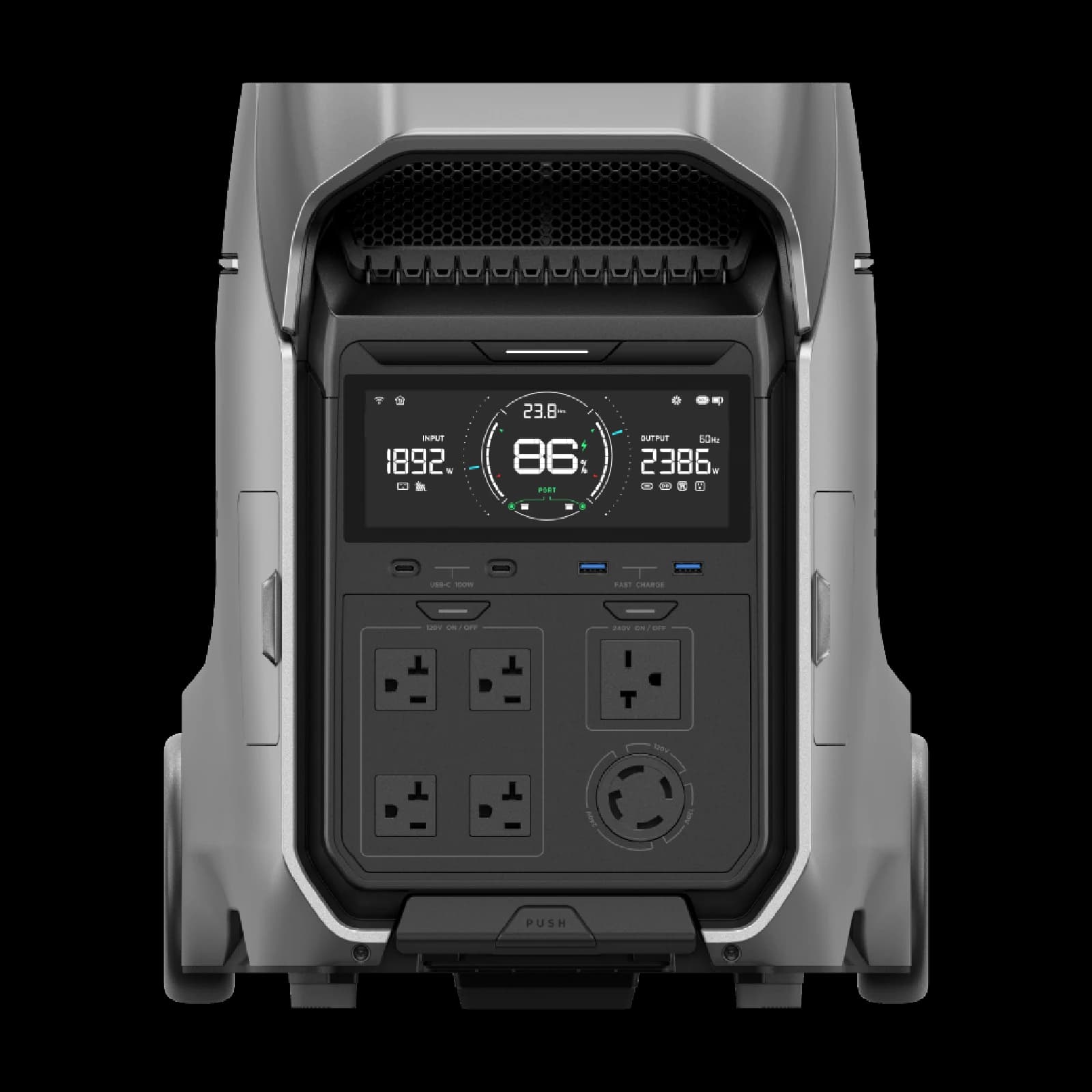
Excellent
#1 of 14
in the XL / home-backup class
Lifted by Capacity & expansion and Durability & longevity; held back by portability.
Check current availability and pricing at the retailer.
See alternatives to the EcoFlow DELTA Pro 3 →At a glance
We review EcoFlow DELTA Pro 3 as a xl / home-backup model. Use output, delivered capacity and startup limits to check your appliances. It supplies 4,000 W of continuous AC output. BatteryRank scores it 76 out of 100 within its size class.
EcoFlow DELTA Pro 3 specs at a glance
Find the reading you need, then follow its source in the full specifications below.
- How much does the EcoFlow DELTA Pro 3 weigh?
51.5 kg (113.5 lb), manufacturer-claimed, without accessories.
Source and date. Show source
claimed sourceus.ecoflow.com ↗2026-07-04- What are the dimensions of the EcoFlow DELTA Pro 3?
410 × 341 × 693 mm (16.1 × 13.4 × 27.3 in), length × width × height, manufacturer-claimed.
Source and date. Show source
claimed sourceus.ecoflow.com ↗2026-07-04- How many watts can the EcoFlow DELTA Pro 3 output?
4,000 W continuous AC output and 8,000 W surge output, manufacturer-claimed. Appliance startup demand must stay within the relevant limit.
Source and date. Show source
claimed sourceus.ecoflow.com ↗2026-07-04- How much solar input can the EcoFlow DELTA Pro 3 accept?
2,600 W maximum solar input, manufacturer-claimed. Actual harvest depends on panel compatibility, sun, orientation, temperature, and conversion losses.
Source and date. Show source
claimed sourceus.ecoflow.com ↗2026-07-04- How far can the EcoFlow DELTA Pro 3 expand?
Up to 48,000 Wh with compatible expansion hardware, manufacturer-claimed. The base-unit capacity and expansion-system capacity are shown separately.
Source and date. Show source
claimed sourceus.ecoflow.com ↗2026-07-04
Our verdict on the EcoFlow DELTA Pro 3
Of every unit in our catalogue this one has the strongest verified delivery: OutdoorGearLab measured 3,790 Wh reaching a load from a 4,096 Wh rating, above 92 percent, where the worst we have recorded is 75. Around that sit 240 V split-phase output, 4,000 W continuous and an expansion ceiling of 48,000 Wh. At 51.5 kg it is furniture rather than luggage, and the question it answers is which circuits stay live, not what you carry camping.
- You want the least gap you can get between the rating and realityThe measured 3,790 Wh against 4,096 Wh rated is the highest verified ratio in our data, and it came from an independent bench rather than a manufacturer estimate.
- Your backup plan includes 240 V circuits and grows over timeSplit-phase output addresses a well pump or a range directly, and the 48,000 Wh ceiling means the platform is nowhere near its limit at the base configuration.
- Anyone needs to move it without equipmentAt 51.5 kg this is beyond a routine one-person lift, and its placement is effectively permanent once decided. It holds 2,042 Wh at 17.9 kg, a third of the mass.
- Everything you want backed up runs on ordinary 120 V outletsThe split-phase capability is most of what justifies 51.5 kg and a 4,000 W inverter, and it contributes nothing to a fridge, a router and some lamps that together rarely pass 500 W. It covers 120 V household loads at 12.5 kg.
The trade-off to weigh: The 48,000 Wh expansion figure describes what the platform permits, not a system anyone assembles. Reaching it means many expansion batteries, each with its own mass and floor space, attached to a base that already weighs 51.5 kg. Treat it as evidence the architecture will not limit you rather than as a capacity you are buying.
What our data can’t tell you: Our strongest measurement for this unit still came from a single outlet that did not publish its test load, so the 92 percent figure cannot be placed on a load curve. We also hold no independent verification of behaviour under an unbalanced 240 V load, which is what an actual house presents and where split-phase inverters are most likely to disappoint.
BatteryRank Engineering Team · Last reviewed · Method
Where to buy
Affiliate links: we may earn a commission if you buy, at no extra cost to you. Commission never affects our rankings.
EcoFlow DELTA Pro 3
Capacity truth
The watt-hour number on the box isn't what reaches your devices. Rated on the label vs what actually leaves an outlet.
4,096 Wh. Show source
claimed sourceus.ecoflow.com ↗2026-07-04The marketing number — total cell capacity.
3,790 Wh. Show source
verified source3790Wh usable at >93% efficiency (OutdoorGearLab) vs 4096 rated2026-07-043790Wh usable at >93% efficiency (OutdoorGearLab) vs 4096 rated · 7% below the label
Also independently measured
- AC inverter efficiency
93 %. Show source
verified source>93% (OutdoorGearLab)2026-07-04- AC charge time
192 min. Show source
verified source~192 min full (OGL measured 3.2h at ~1293Wh/hr, peak ~1600W)2026-07-04- Solar performance
—. Show source
verified sourceOEM supports 2600W solar (High-PV 1600W + Low-PV 1000W)2026-07-04
>93% (OutdoorGearLab)
~192 min full (OGL measured 3.2h at ~1293Wh/hr, peak ~1600W)
OEM supports 2600W solar (High-PV 1600W + Low-PV 1000W)
What it can run
Same sourced device assumptions used by our calculators, applied to this model's usable AC energy. Actual runtime varies with load, temperature, and standby draw.
| Device | Estimated runtime | Sourced assumption |
|---|---|---|
| CPAP (humidifier off) | about 52.6 nights | 9 W · |
| CPAP (heated humidifier on) | about 8.5 nights | 56 W · |
| Refrigerator (full-size) | about 60 hours | 180 W × 35% duty cycle · |
| Wi-Fi router + modem | about 211 hours | 18 W · |
| Laptop (65W charger) | about 117 hours | 65 W × 50% duty cycle · |
| Phone (one full charge) | about 189 full charges | 20 W · |
Who it fits
Mechanical matches against this model's own sourced specs — never invented sentiment, never a guess on a spec we don't have.
3790 Wh AC-delivered (measured) → multiple CPAP nights per charge
4000 W inverter, 3790 Wh AC-delivered (measured) → runs a fridge through an outage
4096 Wh, expandable, 12V DC out → long off-grid stays
How it scores
Four buyer pillars over seven sub-scores — computed from sourced data with a published formula, price-independent by design.
Power
Battery-side usable capacity and how much you can run at once.
Usable watt-hours and how far you can grow it with add-on batteries, versus its size class.
Continuous and surge wattage, outlet count, and USB-C fast-charging.
Trust
Owner reputation, safety record, warranty, and build durability.
Owner ratings, brand reputation, recall record, and warranty backing.
Rated cycle life, warranty length, cell chemistry, and weather sealing.
Charging
Wall and solar recharge speed.
Wall recharge speed, solar input, and multi-source charging.
Livability
62% dataLightweight, portable, and quiet enough to live with.
Weight, footprint, handle, and wheels, versus its size class.
Fan noise under load — quieter is better for bedrooms and CPAP use.
How this score is computed
We score the hardware using sourced specifications and independently attributed measurements. Seven sub-scores form a 0–100 composite, grouped into four buyer pillars. The score is price-independent: a sale changes what you pay, while this analysis evaluates the station's capabilities within its size class.
| Pillar | Built from |
|---|---|
| Power | Capacity & expansion + Output & versatility |
| Trust | Trust & reliability + Durability & longevity |
| Charging | Charging & solar |
| Livability | Portability + Quiet / livability |
Scores are cohort-relative — each model is ranked against others in its size class. Missing inputs renormalize out rather than scoring zero. Incomplete evidence can leave a sub-score unavailable; it does not establish that a model performs well. Any figure resting on a documented estimate is tagged est. Read our scoring and evidence methodology.
Full specifications
Manufacturer-claimed unless marked verified (FCC/UL/DOE/lab). Tap or focus a figure to view its source.
Capacity & battery
- Battery-side usable capacity
4,096 Wh. Show source
claimed sourceus.ecoflow.com ↗2026-07-04- Rated cycle life
4,000 cycles. Show source
claimed sourceus.ecoflow.com ↗2026-07-04- Battery chemistry
LiFePO4. Show source
claimed sourceus.ecoflow.com ↗2026-07-04- Max capacity with expansion
48,000 Wh. Show source
claimed sourceus.ecoflow.com ↗2026-07-04- Rated capacity
4,096 Wh. Show source
claimed sourceus.ecoflow.com ↗2026-07-04- Cycle-life threshold
80 %. Show source
claimed sourceus.ecoflow.com ↗2026-07-04
Energy available from the battery before output-conversion losses. AC-delivered capacity is shown separately in Capacity Truth.
How many full charge-and-drain cycles before the battery drops to its rated threshold (shown alongside — brands rate to different thresholds, so never compare bare cycle counts).
The type of battery cell. LiFePO4 (LFP) cells last far more cycles and are more thermally stable than older lithium-ion (NMC) cells.
The largest total capacity this unit can reach once you add every supported expansion battery.
The battery's nameplate energy capacity — the headline number on the box. Battery-side usable and AC-delivered capacity are shown separately.
The remaining-capacity level the cycle rating is measured to. 3,000 cycles to 80% is a stronger battery than 3,000 cycles to 70% — always read the two numbers together.
Power output
- Continuous power output
4,000 W. Show source
claimed sourceus.ecoflow.com ↗2026-07-04- Surge power output
8,000 W. Show source
claimed sourceus.ecoflow.com ↗2026-07-04- AC outlets
6 outlets. Show source
claimed sourceus.ecoflow.com ↗2026-07-04- USB-A ports
2 ports. Show source
claimed sourceus.ecoflow.com ↗2026-07-04- USB-C ports
2 ports. Show source
claimed sourceus.ecoflow.com ↗2026-07-04- USB-C max output
100 W. Show source
claimed sourceus.ecoflow.com ↗2026-07-04- 12V car ports
1 ports. Show source
claimed sourceus.ecoflow.com ↗2026-07-04- DC barrel ports
1 ports. Show source
claimed sourceus.ecoflow.com ↗2026-07-04- Max combined output
4,000 W. Show source
claimed sourceus.ecoflow.com ↗2026-07-04
The most power you can draw at once, sustained — this has to be higher than the running wattage of whatever you're plugging in.
A brief power spike the unit can absorb when a device first switches on — matters for things with motors or compressors, like fridges.
How many standard wall-style outlets are built in.
How many USB-A ports are built in, for charging older phones, lights, and accessories.
How many USB-C ports are built in — check the per-port wattage below if you need fast charging for a laptop.
The fastest a single USB-C port can charge a device — relevant for laptops and fast-charging phones.
How many car-socket (cigarette-lighter) style 12V outputs are built in. Match the device or its supported converter to the port's voltage and current limits; a CPAP needs its exact model's documented power connection.
How many round barrel-style DC outputs are built in, used by routers, some lights, and older electronics.
The most power the unit can deliver across ALL ports at the same time — can be lower than the AC rating plus every USB port added up.
Charging & solar
- Max solar input
2,600 W. Show source
claimed sourceus.ecoflow.com ↗2026-07-04
The most solar panel wattage the unit can accept — undersized panels just mean slower charging, not damage, but oversizing this is wasted money.
Reliability & durability
- UPS switchover time
10 ms. Show source
claimed sourceus.ecoflow.com ↗2026-07-04
How fast the unit takes over when grid power cuts out. Under ~20ms is fast enough that most electronics — including many CPAP machines — won't even blip.
Size & portability
- Weight
51.5 kg. Show source
claimed sourceus.ecoflow.com ↗2026-07-04
How much the unit weighs on its own, without accessories — relevant for portability and carrying it up stairs during an outage.
What reviewers & owners report
Named outlets and marketplaces, each rating credited where it was published.
- exceptional 4000W/8000W output runs demanding home loads — Across reviewers ·
- native 120/240V + RV outlets — Across reviewers ·
- massive scalable expansion to 48kWh — Across reviewers ·
- fast ~3.2h recharge — Across reviewers ·
- 93% efficient — Across reviewers ·
- quiet — Across reviewers ·
- OGL Top Pick "Best for Home Backup" (81/100) — Across reviewers ·
- very heavy (~114 lb) awkward shape — Across reviewers ·
- high price — Across reviewers ·
- feature/outlet complexity — Across reviewers ·
- Amazon 4.2 suggests some app/firmware or QC gripes — Across reviewers ·
- Wirecutter: none
- Popular Mechanics: none
- widely reviewed as top home-backup/240V pick — YouTube reviewers ·
- praised for output & expandability, dinged for weight — YouTube reviewers ·
- no single measured consensus captured — YouTube reviewers ·
Brand reputation: 2024 flagship; Amazon 4.2/280 (lower than DELTA 3, some app/firmware complaints); OGL & PCMag & TechRadar reviewed favorably for capability. Brand-level: EcoFlow DELTA Max 2000 (EFD310, older gen) fire recall 2025-10 (separate product)
Sources: us.ecoflow.com/products/delta-pro-3-portable-power-station (full on-page Specs) accessed 2026-07-04; amazon.com/dp/B0D14FMFZD accessed 2026-07-04; outdoorgearlab.com (81/100 Top Pick); pcmag.com; techradar.com; rv.com; saferproducts.gov (EcoFlow) checked 2026-07-04
What else to consider instead of the EcoFlow DELTA Pro 3
Same or adjacent size class, ordered by the price-independent composite. Every alternative is better than the EcoFlow DELTA Pro 3 at something and worse at something else, so each row states both halves — each one arithmetic on two sourced readings, with a dimension skipped rather than guessed when either side is missing a figure.
- Bluetti Apex 300score 71 · same size class
- Why you would switch
- The Bluetti Apex 300 is 26% lighter (38 kg vs 51.5 kg).
- What you give up
- The EcoFlow DELTA Pro 3 delivers 48% more usable AC energy (3,790 Wh vs 2,565 Wh).
- Jackery HomePower 3600 Plusscore 66 · same size class
- Why you would switch
- The Jackery HomePower 3600 Plus is 32% lighter (35 kg vs 51.5 kg).
- What you give up
- The EcoFlow DELTA Pro 3 delivers 24% more usable AC energy (3,790 Wh vs 3,046 Wh).
- Anker SOLIX F3800 Plusscore 65 · same size class
- Why you would switch
- The Anker SOLIX F3800 Plus carries 50% more continuous output (6,000 W vs 4,000 W), which decides what it can run at all.
- What you give up
- The EcoFlow DELTA Pro 3 delivers 16% more usable AC energy (3,790 Wh vs 3,264 Wh).
- Pecron E3600LFPscore 63 · same size class
- Why you would switch
- The Pecron E3600LFP is 30% lighter (36 kg vs 51.5 kg).
- What you give up
- The EcoFlow DELTA Pro 3 delivers 45% more usable AC energy (3,790 Wh vs 2,611 Wh).
- Anker SOLIX F3800score 63 · same size class
- Why you would switch
- The Anker SOLIX F3800 carries 50% more continuous output (6,000 W vs 4,000 W), which decides what it can run at all.
- What you give up
- The EcoFlow DELTA Pro 3 delivers 16% more usable AC energy (3,790 Wh vs 3,264 Wh).
Quick answers
Each answer restates a sourced figure from elsewhere on this page — nothing new, nothing guessed.
- How many milliamp-hours (mAh) is the EcoFlow DELTA Pro 3?
- Its manufacturer-claimed capacity is 4,096 Wh. A mAh conversion also needs the battery's nominal voltage: mAh = Wh × 1,000 ÷ V. Our record has no sourced nominal battery voltage, so we leave the mAh figure unspecified. USB output voltage is not a substitute for battery voltage. Compare watt-hours across power stations. Use the mAh to Wh converter.
- How much capacity does the EcoFlow DELTA Pro 3 deliver through an AC outlet?
- About 3,790 Wh of the rated 4,096 Wh reaches an AC outlet from a full charge — measured in independent testing.
- What is the cycle-life rating of the EcoFlow DELTA Pro 3?
- 4,000 cycles to 80% remaining capacity, manufacturer-claimed. A cycle rating is not a calendar-life guarantee.
- Can the EcoFlow DELTA Pro 3 work as a UPS?
- Its manufacturer-claimed transfer time is 10 ms. Confirm that your connected equipment tolerates that transfer time; this is not the same as a zero-transfer online UPS.
Keep exploring
- Best for RV & Van Life#1 of 10
- Best Portable Power Stations#2 of 3
- Best Verified Inverter Efficiency#2 of 10
- Best Medical-Device Backup Power Stations#2 of 5
- Best Expandable Power Stations#4 of 10
- Best for Home Backup#5 of 8
- Best UPS-Capable Power Stations#5 of 10
- Longest-Cycle-Life Power Stations#8 of 10
- Best Power Station Warranty Coverage#9 of 10
- Refrigerator runtime guide
- CPAP nights-per-charge calculator
- How Many Watts Does a Chest Freezer Use?
- How Many Watts Does a 12V Camping Fridge Use?
- How Many Watts Does an RV Refrigerator Use?
- How Many Watts Does an Electric Cooler Use?
- Portable Power for a 12-Hour Outage
- Portable Power for a One-Day Outage
- Power a Refrigerator, Wi-Fi, and Lights
- Complete CPAP Overnight Power Kit
- Complete Refrigerator Outage Kit