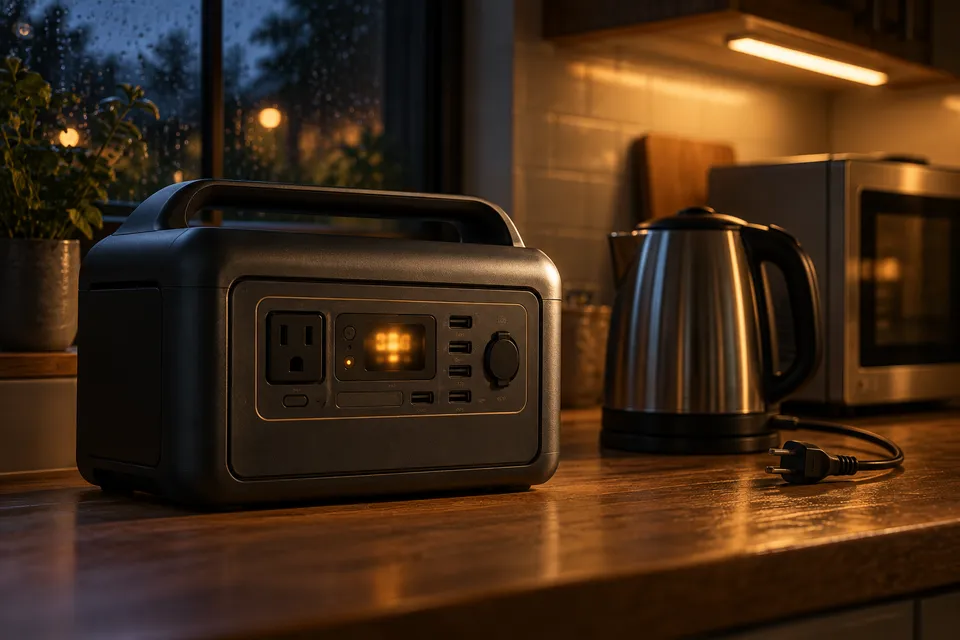
Compare appliance input with station output
These appliance presets are examples with dated sources. The sample station in each row meets the listed running watts and, where provided, surge watts. Check the manuals for startup duration, electrical connection and your actual appliance before relying on that match.
| Appliance | Running draw | Startup surge | Sample rating match | Source |
|---|---|---|---|---|
| Window AC (8,000 BTU) | 650 W | 1,800 W | EcoFlow DELTA 3 | 2026-07-06 |
| Space heater (1,500W) | 1,500 W | Not provided | EcoFlow DELTA 3 | 2026-07-06 |
| Microwave (1,000W cooking power) | 1,500 W | Not provided | EcoFlow DELTA 3 | 2026-07-06 |
| Electric kettle (1.7L) | 1,500 W | Not provided | EcoFlow DELTA 3 | 2026-07-06 |
| Sump pump (1/3 HP) | 800 W | 2,000 W | EcoFlow DELTA 3 | 2026-07-06 |
The table compares published watt ratings. It does not approve every appliance in the same category, and a missing startup figure is a gap to check. Add any simultaneous loads before choosing output.
Watts start it; watt-hours sustain it
Enough output is the first check. Runtime depends on delivered energy and average draw. A sustained heating load can use that energy much faster than an appliance used for a few minutes.
Divide AC-delivered watt-hours by average watts to estimate hours. Use representative measurements for an air conditioner that cycles. A microwave used briefly needs less energy than the same input held continuously, but it still needs enough output while it is on.
Compare output and delivered capacity in the power-station ranking, then enter your appliances and use periods in the sizing tool.
Frequently asked questions
- Can a power station run a space heater?
- Check the heater’s electrical input against the station’s continuous output. Then divide AC-delivered energy by the heater’s average draw to estimate runtime. The heater preset below is one example; read your own appliance’s label and manual.
- What size power station do I need to run a window air conditioner?
- Check the air conditioner’s running input and compressor startup requirement against the station’s continuous and supported surge ratings. Size delivered capacity for the hours you need, using representative average consumption. The example below does not establish a match for every air conditioner.
- Can I run a microwave on a power station?
- Use the microwave’s electrical input rating, which differs from its advertised cooking output. Compare it with continuous station output and any manufacturer-stated startup requirement. Include other appliances you will run at the same time.
- Why will my power station not start a motor appliance?
- The motor may need more power to start than to run. Check startup demand against the station’s surge rating and supported duration. A match on running watts alone is insufficient.
- What is the difference between running watts and surge watts?
- Running watts describe power while the appliance operates. Startup demand is a brief higher draw that some loads require. Compare running input with continuous station output, then check startup against the published surge rating and duration.