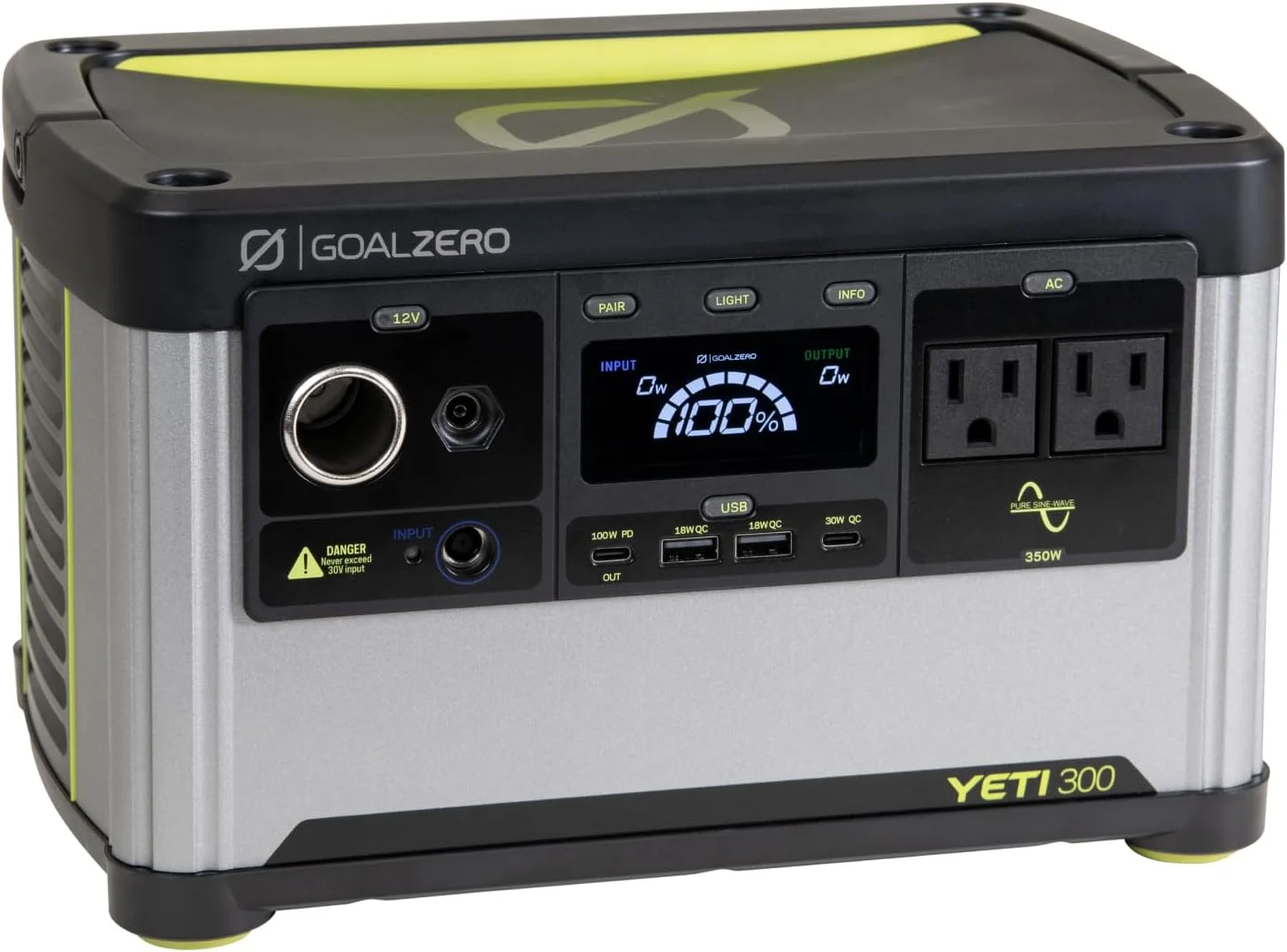
Goal Zero Yeti 300
71BatteryRank score · Excellent
Goal Zero Yeti 300 leads by 17 points overall.
By the BatteryRank Engineering Team
Battery-side usable capacity and how much you can run at once.
Owner reputation, safety record, warranty, and build durability.
Wall and solar recharge speed.
Lightweight, portable, and quiet enough to live with.
Computed from sourced data with a published, price-independent formula. Scores are relative to each model's size class.
The watt-hours on the box aren't what reaches your devices. Same scale, both units.
The marketing number — total cell capacity.
What reaches an AC outlet — about 15% is lost turning battery power into household AC. How we estimate.
The marketing number — total cell capacity.
253Wh discharged at 50W load (Trusted Reviews) vs 288Wh rated · 12% below the label
| Device | Goal Zero Yeti 300 | Jackery Explorer 300 Plus | Assumption |
|---|---|---|---|
| CPAP (humidifier off) | about 3.5 nights | about 3.5 nights | 9 W · |
| CPAP (heated humidifier on) | about 0.6 nights | about 0.6 nights | 56 W · |
| Refrigerator (full-size) | about 4.0 hours | about 4.0 hours | 180 W × 35% duty cycle · |
| Wi-Fi router + modem | about 14 hours | about 14 hours | 18 W · |
| Laptop (65W charger) | about 7.8 hours | about 7.8 hours | 65 W × 50% duty cycle · |
| Phone (one full charge) | about 12 full charges | about 12 full charges | 20 W · |
One device at a time; estimates use each station's usable AC energy. Build your own load →
| Spec | Goal Zero Yeti 300 | Jackery Explorer 300 Plus |
|---|---|---|
| AC-delivered capacity | 252 Whest.. Show sourceestimated sourcehelp.goalzero.com ↗2026-07-27 | 253 Whverified. Show sourceverified source253Wh discharged at 50W load (Trusted Reviews) vs 288Wh rated2026-07-04 |
| Continuous power output | 350 W. Show sourceclaimed sourcehelp.goalzero.com ↗2026-07-27 | 300 W. Show sourceclaimed sourcejackery.com ↗2026-07-04 |
| Surge power output | 600 W. Show sourceclaimed sourcehelp.goalzero.com ↗2026-07-27 | 600 W. Show sourceclaimed sourcejackery.com ↗2026-07-04 |
| Max solar input | 200 W. Show sourceclaimed sourcehelp.goalzero.com ↗2026-07-27 | 100 W. Show sourceclaimed sourcejackery.com ↗2026-07-04 |
| AC charge time (0–100%) | — | 120 min. Show sourceclaimed sourcejackery.com ↗2026-07-04 |
| Weight | 6.2 kg. Show sourceclaimed sourcehelp.goalzero.com ↗2026-07-27 | 3.75 kg. Show sourceclaimed sourcejackery.com ↗2026-07-04 |
| Rated cycle life | 4,000 cycles. Show sourceclaimed sourcehelp.goalzero.com ↗2026-07-27 | 3,000 cycles. Show sourceclaimed sourcejackery.com ↗2026-07-04 |
Manufacturer figures unless marked verified or est. Tap or focus a figure to view its source. The better reading in each row is highlighted — lower wins for weight and recharge time.
Where to buy
Affiliate links: we may earn a commission if you buy, at no extra cost to you. Commission never affects our rankings.
Goal Zero Yeti 300
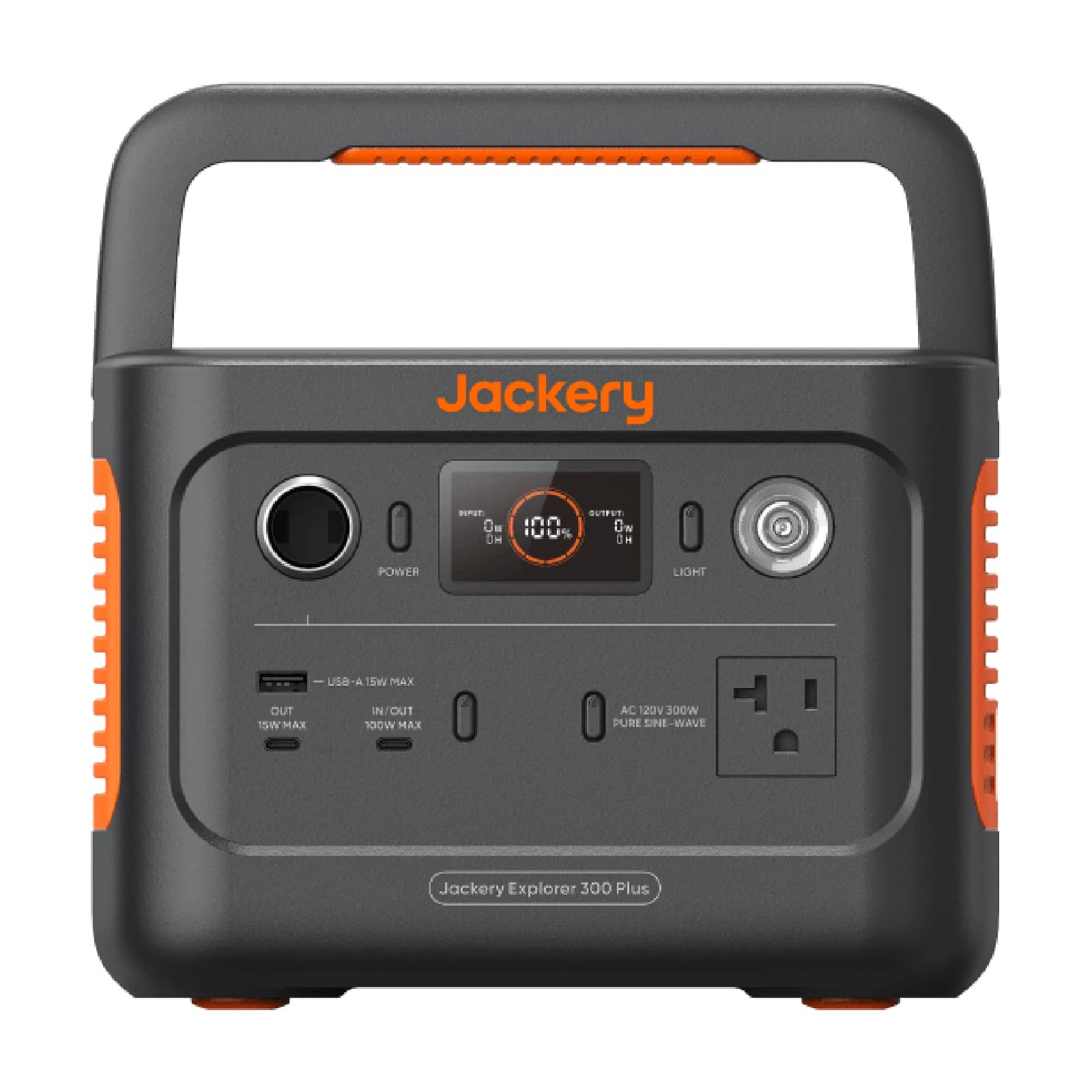
Jackery Explorer 300 Plus