EcoFlow RIVER 3 Plus
- AC delivered · est.
243 Wh. Show source
estimated sourceus.ecoflow.com ↗2026-07-04- output
600 W. Show source
claimed sourceus.ecoflow.com ↗2026-07-04- surge
1,200 W. Show source
claimed sourceus.ecoflow.com ↗2026-07-04- weight
4.72 kg. Show source
claimed sourceus.ecoflow.com ↗2026-07-04- recharge
60 min. Show source
claimed sourceus.ecoflow.com ↗2026-07-04
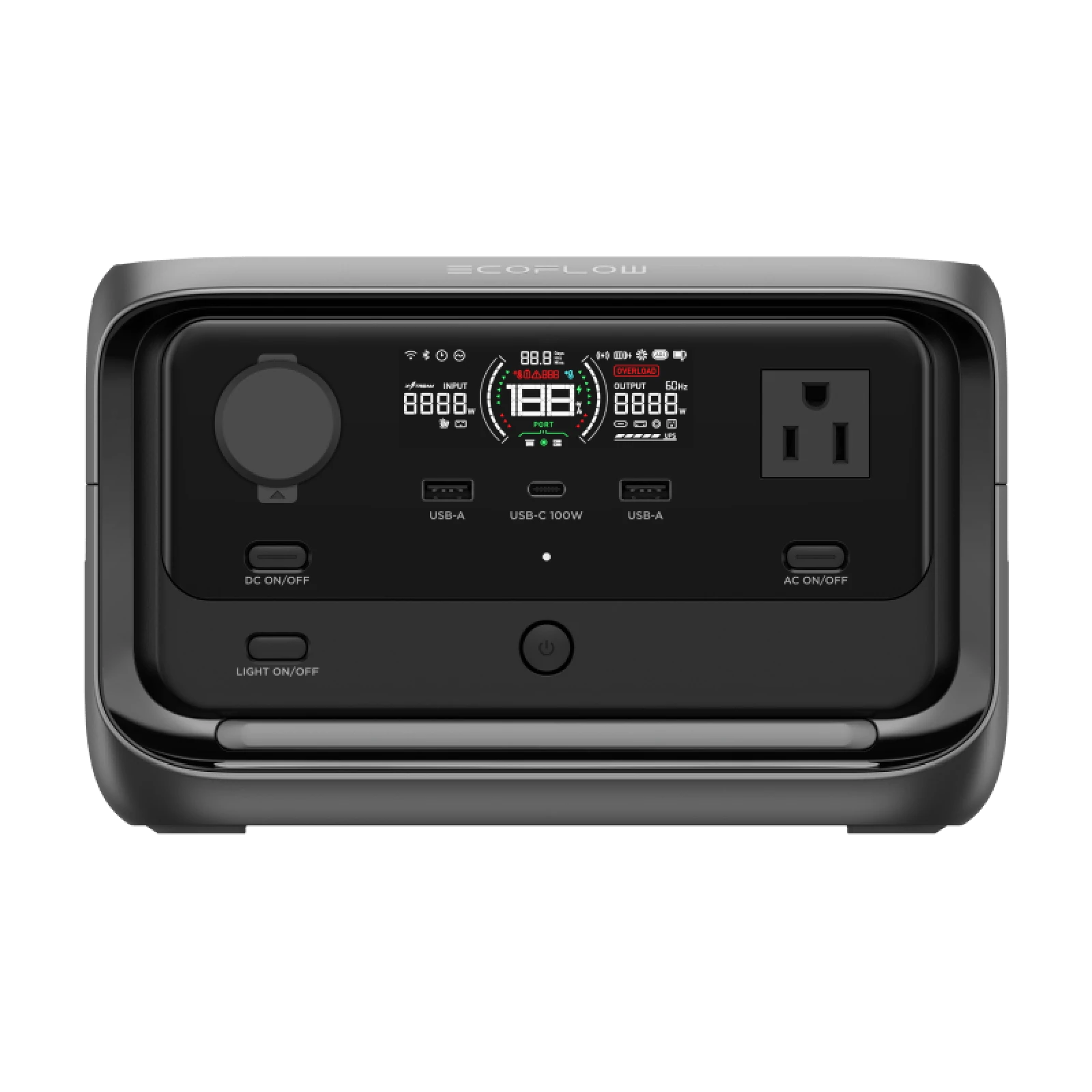
Balanced
#2 of 14
in the Ultraportable / carry class
Lifted by Output & versatility and Charging & solar; held back by portability.
Check current availability and pricing at the retailer.
See alternatives to the EcoFlow RIVER 3 Plus →At a glance
We review EcoFlow RIVER 3 Plus as a ultraportable / carry model. Use output, delivered capacity and startup limits to check your appliances. It supplies 600 W of continuous AC output. BatteryRank scores it 65 out of 100 within its size class.
EcoFlow RIVER 3 Plus specs at a glance
Find the reading you need, then follow its source in the full specifications below.
- How much does the EcoFlow RIVER 3 Plus weigh?
4.72 kg (10.4 lb), manufacturer-claimed, without accessories.
Source and date. Show source
claimed sourceus.ecoflow.com ↗2026-07-04- What are the dimensions of the EcoFlow RIVER 3 Plus?
234 × 231 × 147 mm (9.2 × 9.1 × 5.8 in), length × width × height, manufacturer-claimed.
Source and date. Show source
claimed sourceus.ecoflow.com ↗2026-07-04- How long does the EcoFlow RIVER 3 Plus take to charge?
1 h from a wall outlet, 0 to 100%, manufacturer-claimed. Fast-charge modes and solar input differ — see the charging specs on this page.
Source and date. Show source
claimed sourceus.ecoflow.com ↗2026-07-04- How many watts can the EcoFlow RIVER 3 Plus output?
600 W continuous AC output and 1,200 W surge output, manufacturer-claimed. Appliance startup demand must stay within the relevant limit.
Source and date. Show source
claimed sourceus.ecoflow.com ↗2026-07-04- How much solar input can the EcoFlow RIVER 3 Plus accept?
220 W maximum solar input, manufacturer-claimed. Actual harvest depends on panel compatibility, sun, orientation, temperature, and conversion losses.
Source and date. Show source
claimed sourceus.ecoflow.com ↗2026-07-04- How far can the EcoFlow RIVER 3 Plus expand?
Up to 858 Wh with compatible expansion hardware, manufacturer-claimed. The base-unit capacity and expansion-system capacity are shown separately.
Source and date. Show source
claimed sourceus.ecoflow.com ↗2026-07-04
Our verdict on the EcoFlow RIVER 3 Plus
The name misleads people: this is not a bigger RIVER 3, it is a stronger one. Capacity moves only 245 to 286 Wh — under 17% and inside the range most buyers would never notice — while continuous output doubles from 300 W to 600 W and the sealed pack becomes a platform that accepts one Extra Battery for 858 Wh total. Buy it for the doubled inverter and the expansion port. If you buy it expecting meaningfully more battery, you will feel misled by roughly 41 Wh.
- You need 600 W available now but want a path to roughly triple the reserve laterOne Extra Battery takes the system from 286 Wh to 858 Wh, so the expansion decision can wait until you know what your actual overnight draw looks like.
- You want to keep a desktop or network rack alive through brief cutsSwitchover is under 10 ms here, half the base model's 20 ms, and 3 AC sockets share a 600 W budget rather than 300 W — enough for a PC and a monitor together.
- Solar is your main recharge pathThe 220 W solar ceiling is double the base model's 110 W, over a wider 11-55 V window, which is what takes the claimed full solar charge from 2.6 hours down to 1.5.
- You are buying it because "Plus" sounds like more batteryThe gain is 41 Wh, or under 17%. That is a few extra minutes on a laptop, and it comes with 1.18 kg of extra mass — the trade is almost entirely about output and expandability, not endurance. The base RIVER 3 is 3.54 kg for nearly the same pack.
- You already know you need to run a fridge or space heater for hoursEven fully expanded at 858 Wh this is a supplementary reserve, and the 600 W continuous limit rules out heating elements entirely. Expansion raises endurance, never the output ceiling. The DELTA 3 Max carries 2,048 Wh behind a 2,400 W inverter.
The trade-off to weigh: Expandability is the headline and it has a hard limit that the marketing does not lead with: the ceiling is 1 additional battery, full stop. So 858 Wh is not a stepping stone toward a larger system, it is the end of the road for this chassis. Anyone whose plan involves stacking several batteries over time is looking at the wrong product line.
What our data can’t tell you: Nobody independent has published a noise measurement for this model, unlike the base RIVER 3, so the sub-30 dB figure here rests on EcoFlow's own claim and should be read that way. Our sourced car-charging time of 3.3 hours is also longer than the base model's 2.8 despite a higher rated car input, and we have no explanation we can source for that.
BatteryRank Engineering Team · Last reviewed · Method
Where to buy
Affiliate links: we may earn a commission if you buy, at no extra cost to you. Commission never affects our rankings.
EcoFlow RIVER 3 Plus
Capacity truth
The watt-hour number on the box isn't what reaches your devices. Rated on the label vs what actually leaves an outlet.
286 Wh. Show source
claimed sourceus.ecoflow.com ↗2026-07-04The marketing number — total cell capacity.
243 Wh. Show source
estimated sourceestimate = battery-side usable capacity × 85% inverter efficiencyWhat reaches an AC outlet — about 15% is lost turning battery power into household AC. How we estimate.
Also independently measured
- AC charge time
60 min. Show source
verified source~60 min AC (OEM; reviewers confirm ~1 hr)2026-07-04
~60 min AC (OEM; reviewers confirm ~1 hr)
What it can run
Same sourced device assumptions used by our calculators, applied to this model's usable AC energy. Actual runtime varies with load, temperature, and standby draw.
| Device | Estimated runtime | Sourced assumption |
|---|---|---|
| CPAP (humidifier off) | about 3.4 nights | 9 W · |
| CPAP (heated humidifier on) | about 0.5 nights | 56 W · |
| Refrigerator (full-size) | about 3.9 hours | 180 W × 35% duty cycle · |
| Wi-Fi router + modem | about 14 hours | 18 W · |
| Laptop (65W charger) | about 7.5 hours | 65 W × 50% duty cycle · |
| Phone (one full charge) | about 12 full charges | 20 W · |
Who it fits
Mechanical matches against this model's own sourced specs — never invented sentiment, never a guess on a spec we don't have.
4.72 kg with 220 W solar input → carry-in, solar-rechargeable
How it scores
Four buyer pillars over seven sub-scores — computed from sourced data with a published formula, price-independent by design.
Power
Battery-side usable capacity and how much you can run at once.
Usable watt-hours and how far you can grow it with add-on batteries, versus its size class.
Continuous and surge wattage, outlet count, and USB-C fast-charging.
Trust
Owner reputation, safety record, warranty, and build durability.
Owner ratings, brand reputation, recall record, and warranty backing.
Rated cycle life, warranty length, cell chemistry, and weather sealing.
Charging
Wall and solar recharge speed.
Wall recharge speed, solar input, and multi-source charging.
Livability
62% dataLightweight, portable, and quiet enough to live with.
Weight, footprint, handle, and wheels, versus its size class.
Fan noise under load — quieter is better for bedrooms and CPAP use.
How this score is computed
We score the hardware using sourced specifications and independently attributed measurements. Seven sub-scores form a 0–100 composite, grouped into four buyer pillars. The score is price-independent: a sale changes what you pay, while this analysis evaluates the station's capabilities within its size class.
| Pillar | Built from |
|---|---|
| Power | Capacity & expansion + Output & versatility |
| Trust | Trust & reliability + Durability & longevity |
| Charging | Charging & solar |
| Livability | Portability + Quiet / livability |
Scores are cohort-relative — each model is ranked against others in its size class. Missing inputs renormalize out rather than scoring zero. Incomplete evidence can leave a sub-score unavailable; it does not establish that a model performs well. Any figure resting on a documented estimate is tagged est. Read our scoring and evidence methodology.
Full specifications
Manufacturer-claimed unless marked verified (FCC/UL/DOE/lab). Tap or focus a figure to view its source.
Capacity & battery
- Battery-side usable capacity
286 Wh. Show source
claimed sourceus.ecoflow.com ↗2026-07-04- Rated cycle life
3,000 cycles. Show source
claimed sourceus.ecoflow.com ↗2026-07-04- Battery chemistry
LiFePO4. Show source
claimed sourceus.ecoflow.com ↗2026-07-04- Max capacity with expansion
858 Wh. Show source
claimed sourceus.ecoflow.com ↗2026-07-04- Rated capacity
286 Wh. Show source
claimed sourceus.ecoflow.com ↗2026-07-04- Cycle-life threshold
80 %. Show source
claimed sourceus.ecoflow.com ↗2026-07-04- Battery voltage
22.4 V. Show source
claimed sourceus.ecoflow.com ↗2026-07-04- Battery amp-hours
12.8 Ah. Show source
claimed sourceus.ecoflow.com ↗2026-07-04
Energy available from the battery before output-conversion losses. AC-delivered capacity is shown separately in Capacity Truth.
How many full charge-and-drain cycles before the battery drops to its rated threshold (shown alongside — brands rate to different thresholds, so never compare bare cycle counts).
The type of battery cell. LiFePO4 (LFP) cells last far more cycles and are more thermally stable than older lithium-ion (NMC) cells.
The largest total capacity this unit can reach once you add every supported expansion battery.
The battery's nameplate energy capacity — the headline number on the box. Battery-side usable and AC-delivered capacity are shown separately.
The remaining-capacity level the cycle rating is measured to. 3,000 cycles to 80% is a stronger battery than 3,000 cycles to 70% — always read the two numbers together.
The internal battery pack's nominal voltage — mostly useful for cross-checking capacity math (volts × amp-hours ≈ watt-hours).
The pack's charge capacity in amp-hours at its nominal voltage — another way to state capacity; watt-hours is the number to compare across units.
Power output
- Continuous power output
600 W. Show source
claimed sourceus.ecoflow.com ↗2026-07-04- Surge power output
1,200 W. Show source
claimed sourceus.ecoflow.com ↗2026-07-04- AC outlets
3 outlets. Show source
claimed sourceus.ecoflow.com ↗2026-07-04- USB-A ports
2 ports. Show source
claimed sourceus.ecoflow.com ↗2026-07-04- USB-C ports
1 ports. Show source
claimed sourceus.ecoflow.com ↗2026-07-04- USB-C max output
100 W. Show source
claimed sourceus.ecoflow.com ↗2026-07-04- 12V car ports
1 ports. Show source
claimed sourceus.ecoflow.com ↗2026-07-04- DC barrel ports
0 ports. Show source
claimed sourceus.ecoflow.com ↗2026-07-04- Max combined output
600 W. Show source
claimed sourceus.ecoflow.com ↗2026-07-04
The most power you can draw at once, sustained — this has to be higher than the running wattage of whatever you're plugging in.
A brief power spike the unit can absorb when a device first switches on — matters for things with motors or compressors, like fridges.
How many standard wall-style outlets are built in.
How many USB-A ports are built in, for charging older phones, lights, and accessories.
How many USB-C ports are built in — check the per-port wattage below if you need fast charging for a laptop.
The fastest a single USB-C port can charge a device — relevant for laptops and fast-charging phones.
How many car-socket (cigarette-lighter) style 12V outputs are built in. Match the device or its supported converter to the port's voltage and current limits; a CPAP needs its exact model's documented power connection.
How many round barrel-style DC outputs are built in, used by routers, some lights, and older electronics.
The most power the unit can deliver across ALL ports at the same time — can be lower than the AC rating plus every USB port added up.
Charging & solar
- AC recharge speed
380 W. Show source
claimed sourceus.ecoflow.com ↗2026-07-04- AC charge time (0–100%)
60 min. Show source
claimed sourceus.ecoflow.com ↗2026-07-04- Max solar input
220 W. Show source
claimed sourceus.ecoflow.com ↗2026-07-04
How fast the unit recharges from a wall outlet — higher means shorter waits between uses.
How long a full recharge takes from a wall outlet, start to finish.
The most solar panel wattage the unit can accept — undersized panels just mean slower charging, not damage, but oversizing this is wasted money.
Reliability & durability
- UPS switchover time
10 ms. Show source
claimed sourceus.ecoflow.com ↗2026-07-04
How fast the unit takes over when grid power cuts out. Under ~20ms is fast enough that most electronics — including many CPAP machines — won't even blip.
Size & portability
- Weight
4.72 kg. Show source
claimed sourceus.ecoflow.com ↗2026-07-04
How much the unit weighs on its own, without accessories — relevant for portability and carrying it up stairs during an outage.
What reviewers & owners report
Named outlets and marketplaces, each rating credited where it was published.
- expandable to 858Wh (wire-free Extra Battery) — Across reviewers ·
- fast <10ms UPS — Across reviewers ·
- 600W/1200W X-Boost from a compact unit — Across reviewers ·
- 1-hr recharge — Across reviewers ·
- quiet <30dB — Across reviewers ·
- built-in light — Across reviewers ·
- 5-yr warranty — Across reviewers ·
- strong value — Across reviewers ·
- base 286Wh limits runtime — Across reviewers ·
- single USB-C — Across reviewers ·
- expansion-capacity claims vary between review sites (858 vs 572Wh) — Across reviewers ·
- no 240V — Across reviewers ·
- Wirecutter: none
- Popular Mechanics: reviewed — Best for light home backup / home-office UPS / short camping source ↗
- covered as a compact expandable value pick — YouTube reviewers ·
- no single measured consensus captured — YouTube reviewers ·
Brand reputation: Popular 2024 compact expandable; Amazon 4.5/357. Popular Mechanics recommends for light home backup. Brand-level: note EcoFlow DELTA Max 2000 (EFD310) fire recall 2025-10 (separate line)
Sources: us.ecoflow.com/products/river-3-plus-portable-power-station (on-page Specs) accessed 2026-07-04; amazon.com/dp/B0DCCB657J accessed 2026-07-04; popularmechanics.com review; storagereview.com; the-gadgeteer.com; backuppowerhub.com; saferproducts.gov (EcoFlow) checked 2026-07-04
What else to consider instead of the EcoFlow RIVER 3 Plus
Same or adjacent size class, ordered by the price-independent composite. Every alternative is better than the EcoFlow RIVER 3 Plus at something and worse at something else, so each row states both halves — each one arithmetic on two sourced readings, with a dimension skipped rather than guessed when either side is missing a figure.
- Goal Zero Yeti 300score 71 · same size class
- Why you would switch
- The Goal Zero Yeti 300 reaches a full AC charge in 42 minutes against 60.
- What you give up
- The EcoFlow RIVER 3 Plus carries 71% more continuous output (600 W vs 350 W), which decides what it can run at all.
- Bluetti Elite 30 V2score 63 · same size class
- Why you would switch
- The Bluetti Elite 30 V2 reaches a full AC charge in 45 minutes against 60.
- What you give up
- The EcoFlow RIVER 3 Plus supports add-on batteries, so capacity can grow later.
- Anker SOLIX C300score 62 · same size class
- Why you would switch
- The Anker SOLIX C300 delivers 11% more usable AC energy (269 Wh vs 243 Wh).
- What you give up
- The EcoFlow RIVER 3 Plus carries 100% more continuous output (600 W vs 300 W), which decides what it can run at all.
- EcoFlow RIVER 3score 55 · same size class
- Why you would switch
- The EcoFlow RIVER 3 is 25% lighter (3.54 kg vs 4.72 kg).
- What you give up
- The EcoFlow RIVER 3 Plus delivers 17% more usable AC energy (243 Wh vs 208 Wh).
- Jackery Explorer 300score 54 · same size class
- Why you would switch
- The Jackery Explorer 300 is 28% lighter (3.4 kg vs 4.72 kg).
- What you give up
- The EcoFlow RIVER 3 Plus carries 100% more continuous output (600 W vs 300 W), which decides what it can run at all.
Quick answers
Each answer restates a sourced figure from elsewhere on this page — nothing new, nothing guessed.
- How many amp-hours (Ah) or milliamp-hours (mAh) is the EcoFlow RIVER 3 Plus?
- 12.8 Ah (12,800 mAh) at its nominal 22.4 V, manufacturer-claimed. Watt-hours is the number to compare across units. Use the mAh to Wh converter.
- How much capacity does the EcoFlow RIVER 3 Plus deliver through an AC outlet?
- About 243 Wh of the rated 286 Wh reaches an AC outlet from a full charge — an estimate after our published 15% inverter-loss constant (marked est. on this page).
- What is the cycle-life rating of the EcoFlow RIVER 3 Plus?
- 3,000 cycles to 80% remaining capacity, manufacturer-claimed. A cycle rating is not a calendar-life guarantee.
- Can the EcoFlow RIVER 3 Plus work as a UPS?
- Its manufacturer-claimed transfer time is 10 ms. Confirm that your connected equipment tolerates that transfer time; this is not the same as a zero-transfer online UPS.