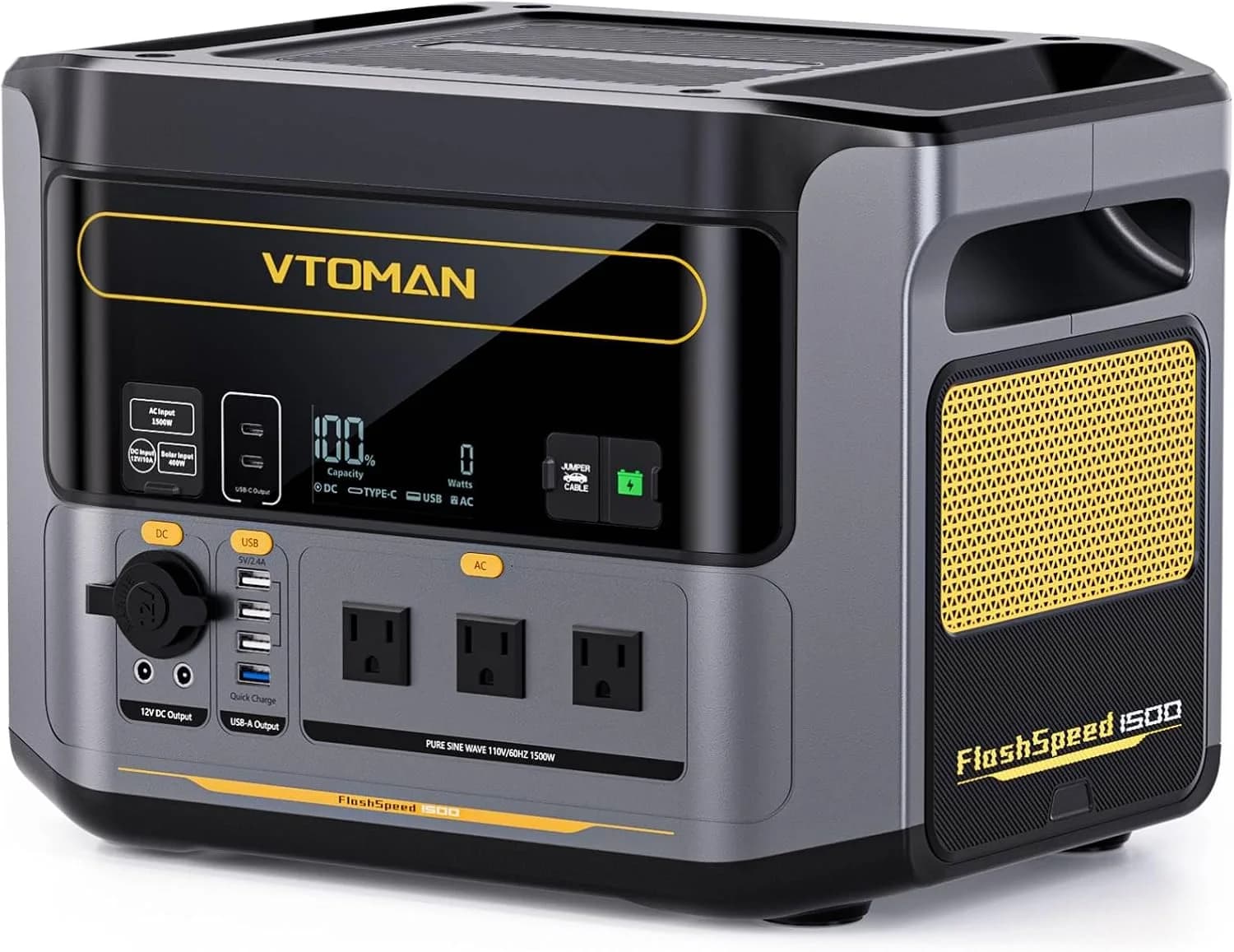
VTOMAN FlashSpeed 1500
- AC delivered · est.
1,316 Wh. Show source
estimated sourcem.media-amazon.com ↗2026-07-27- output
1,500 W. Show source
claimed sourcem.media-amazon.com ↗2026-07-27- surge
3,000 W. Show source
claimed sourcem.media-amazon.com ↗2026-07-27- weight
18.8 kg. Show source
claimed sourcem.media-amazon.com ↗2026-07-27- recharge
60 min. Show source
claimed sourcem.media-amazon.com ↗2026-07-27
Balanced
#16 of 20
in the Large (2 kWh class) class
Lifted by Charging & solar and Portability; held back by capacity & expansion.
Check current availability and pricing at the retailer.
See alternatives to the VTOMAN FlashSpeed 1500 →At a glance
We review VTOMAN FlashSpeed 1500 as a large (2 kwh class) model. Use output, delivered capacity and startup limits to check your appliances. It supplies 1,500 W of continuous AC output. BatteryRank scores it 50 out of 100 within its size class.
VTOMAN FlashSpeed 1500 specs at a glance
Find the reading you need, then follow its source in the full specifications below.
- How much does the VTOMAN FlashSpeed 1500 weigh?
18.8 kg (41.4 lb), manufacturer-claimed, without accessories.
Source and date. Show source
claimed sourcem.media-amazon.com ↗2026-07-27- What are the dimensions of the VTOMAN FlashSpeed 1500?
393 × 280 × 270 mm (15.5 × 11 × 10.6 in), length × width × height, manufacturer-claimed.
Source and date. Show source
claimed sourcem.media-amazon.com ↗2026-07-27- How long does the VTOMAN FlashSpeed 1500 take to charge?
1 h from a wall outlet, 0 to 100%, manufacturer-claimed. Fast-charge modes and solar input differ — see the charging specs on this page.
Source and date. Show source
claimed sourcem.media-amazon.com ↗2026-07-27- How many watts can the VTOMAN FlashSpeed 1500 output?
1,500 W continuous AC output and 3,000 W surge output, manufacturer-claimed. Appliance startup demand must stay within the relevant limit.
Source and date. Show source
claimed sourcem.media-amazon.com ↗2026-07-27- How much solar input can the VTOMAN FlashSpeed 1500 accept?
400 W maximum solar input, manufacturer-claimed. Actual harvest depends on panel compatibility, sun, orientation, temperature, and conversion losses.
Source and date. Show source
claimed sourcem.media-amazon.com ↗2026-07-27- How far can the VTOMAN FlashSpeed 1500 expand?
Up to 3,096 Wh with compatible expansion hardware, manufacturer-claimed. The base-unit capacity and expansion-system capacity are shown separately.
Source and date. Show source
claimed sourcem.media-amazon.com ↗2026-07-27
Capacity truth
The watt-hour number on the box isn't what reaches your devices. Rated on the label vs what actually leaves an outlet.
1,548 Wh. Show source
claimed sourcem.media-amazon.com ↗2026-07-27The marketing number — total cell capacity.
1,316 Wh. Show source
estimated sourceestimate = battery-side usable capacity × 85% inverter efficiencyWhat reaches an AC outlet — about 15% is lost turning battery power into household AC. How we estimate.
What it can run
Same sourced device assumptions used by our calculators, applied to this model's usable AC energy. Actual runtime varies with load, temperature, and standby draw.
| Device | Estimated runtime | Sourced assumption |
|---|---|---|
| CPAP (humidifier off) | about 18.3 nights | 9 W · |
| CPAP (heated humidifier on) | about 2.9 nights | 56 W · |
| Refrigerator (full-size) | about 21 hours | 180 W × 35% duty cycle · |
| Wi-Fi router + modem | about 73 hours | 18 W · |
| Laptop (65W charger) | about 40 hours | 65 W × 50% duty cycle · |
| Phone (one full charge) | about 65 full charges | 20 W · |
Who it fits
Mechanical matches against this model's own sourced specs — never invented sentiment, never a guess on a spec we don't have.
1316 Wh AC-delivered (est.) → multiple CPAP nights per charge
1500 W inverter, 1316 Wh AC-delivered (est.) → runs a fridge through an outage
1548 Wh, expandable, 12V DC out → long off-grid stays
How it scores
Four buyer pillars over seven sub-scores — computed from sourced data with a published formula, price-independent by design.
Power
est.Battery-side usable capacity and how much you can run at once.
Usable watt-hours and how far you can grow it with add-on batteries, versus its size class.
Continuous and surge wattage, outlet count, and USB-C fast-charging.
Trust
42% dataOwner reputation, safety record, warranty, and build durability.
Owner ratings, brand reputation, recall record, and warranty backing.
Rated cycle life, warranty length, cell chemistry, and weather sealing.
Charging
Wall and solar recharge speed.
Wall recharge speed, solar input, and multi-source charging.
Livability
62% dataLightweight, portable, and quiet enough to live with.
Weight, footprint, handle, and wheels, versus its size class.
Fan noise under load — quieter is better for bedrooms and CPAP use.
How this score is computed
We score the hardware using sourced specifications and independently attributed measurements. Seven sub-scores form a 0–100 composite, grouped into four buyer pillars. The score is price-independent: a sale changes what you pay, while this analysis evaluates the station's capabilities within its size class.
| Pillar | Built from |
|---|---|
| Power | Capacity & expansion + Output & versatility |
| Trust | Trust & reliability + Durability & longevity |
| Charging | Charging & solar |
| Livability | Portability + Quiet / livability |
Scores are cohort-relative — each model is ranked against others in its size class. Missing inputs renormalize out rather than scoring zero. Incomplete evidence can leave a sub-score unavailable; it does not establish that a model performs well. Any figure resting on a documented estimate is tagged est. Read our scoring and evidence methodology.
Full specifications
Manufacturer-claimed unless marked verified (FCC/UL/DOE/lab). Tap or focus a figure to view its source.
Capacity & battery
- Rated cycle life
3,000 cycles. Show source
claimed sourcem.media-amazon.com ↗2026-07-27- Battery chemistry
LiFePO4. Show source
claimed sourcem.media-amazon.com ↗2026-07-27- Max capacity with expansion
3,096 Wh. Show source
claimed sourcem.media-amazon.com ↗2026-07-27- Rated capacity
1,548 Wh. Show source
claimed sourcem.media-amazon.com ↗2026-07-27- Cycle-life threshold
80 %. Show source
claimed sourcem.media-amazon.com ↗2026-07-27
How many full charge-and-drain cycles before the battery drops to its rated threshold (shown alongside — brands rate to different thresholds, so never compare bare cycle counts).
The type of battery cell. LiFePO4 (LFP) cells last far more cycles and are more thermally stable than older lithium-ion (NMC) cells.
The largest total capacity this unit can reach once you add every supported expansion battery.
The battery's nameplate energy capacity — the headline number on the box. Battery-side usable and AC-delivered capacity are shown separately.
The remaining-capacity level the cycle rating is measured to. 3,000 cycles to 80% is a stronger battery than 3,000 cycles to 70% — always read the two numbers together.
Power output
- Continuous power output
1,500 W. Show source
claimed sourcem.media-amazon.com ↗2026-07-27- Surge power output
3,000 W. Show source
claimed sourcem.media-amazon.com ↗2026-07-27- AC outlets
3 outlets. Show source
claimed sourcem.media-amazon.com ↗2026-07-27- USB-A ports
4 ports. Show source
claimed sourcem.media-amazon.com ↗2026-07-27- USB-C ports
2 ports. Show source
claimed sourcem.media-amazon.com ↗2026-07-27- USB-C max output
100 W. Show source
claimed sourcem.media-amazon.com ↗2026-07-27- 12V car ports
1 ports. Show source
claimed sourcem.media-amazon.com ↗2026-07-27- DC barrel ports
2 ports. Show source
claimed sourcem.media-amazon.com ↗2026-07-27
The most power you can draw at once, sustained — this has to be higher than the running wattage of whatever you're plugging in.
A brief power spike the unit can absorb when a device first switches on — matters for things with motors or compressors, like fridges.
How many standard wall-style outlets are built in.
How many USB-A ports are built in, for charging older phones, lights, and accessories.
How many USB-C ports are built in — check the per-port wattage below if you need fast charging for a laptop.
The fastest a single USB-C port can charge a device — relevant for laptops and fast-charging phones.
How many car-socket (cigarette-lighter) style 12V outputs are built in. Match the device or its supported converter to the port's voltage and current limits; a CPAP needs its exact model's documented power connection.
How many round barrel-style DC outputs are built in, used by routers, some lights, and older electronics.
Charging & solar
- AC recharge speed
1,500 W. Show source
claimed sourcem.media-amazon.com ↗2026-07-27- AC charge time (0–100%)
60 min. Show source
claimed sourcem.media-amazon.com ↗2026-07-27- Max solar input
400 W. Show source
claimed sourcem.media-amazon.com ↗2026-07-27
How fast the unit recharges from a wall outlet — higher means shorter waits between uses.
How long a full recharge takes from a wall outlet, start to finish.
The most solar panel wattage the unit can accept — undersized panels just mean slower charging, not damage, but oversizing this is wasted money.
Size & portability
- Weight
18.8 kg. Show source
claimed sourcem.media-amazon.com ↗2026-07-27
How much the unit weighs on its own, without accessories — relevant for portability and carrying it up stairs during an outage.
What reviewers & owners report
Named outlets and marketplaces, each rating credited where it was published.
What else to consider instead of the VTOMAN FlashSpeed 1500
Same or adjacent size class, ordered by the price-independent composite. Every alternative is better than the VTOMAN FlashSpeed 1500 at something and worse at something else, so each row states both halves — each one arithmetic on two sourced readings, with a dimension skipped rather than guessed when either side is missing a figure.
- DJI Power 2000score 75 · same size class
- Why you would switch
- The DJI Power 2000 delivers 32% more usable AC energy (1,741 Wh vs 1,316 Wh).
- What you give up
- The VTOMAN FlashSpeed 1500 is 15% lighter (18.8 kg vs 22 kg).
- Aferiy P280score 74 · same size class
- Why you would switch
- The Aferiy P280 delivers 32% more usable AC energy (1,741 Wh vs 1,316 Wh).
- What you give up
- The VTOMAN FlashSpeed 1500 is 13% lighter (18.8 kg vs 21.6 kg).
- Oupes Mega 2 Proscore 69 · same size class
- Why you would switch
- The Oupes Mega 2 Pro delivers 32% more usable AC energy (1,741 Wh vs 1,316 Wh).
- What you give up
- The VTOMAN FlashSpeed 1500 is 15% lighter (18.8 kg vs 22.1 kg).
- Anker SOLIX C2000 Gen 2score 68 · same size class
- Why you would switch
- The Anker SOLIX C2000 Gen 2 delivers 34% more usable AC energy (1,761 Wh vs 1,316 Wh).
- What you give up
- The VTOMAN FlashSpeed 1500 reaches a full AC charge in 60 minutes against 88.
- Bluetti Elite 200 v2score 68 · same size class
- Why you would switch
- The Bluetti Elite 200 v2 delivers 58% more usable AC energy (2,074 Wh vs 1,316 Wh).
- What you give up
- The VTOMAN FlashSpeed 1500 is 22% lighter (18.8 kg vs 24.2 kg).
Quick answers
Each answer restates a sourced figure from elsewhere on this page — nothing new, nothing guessed.
- How many milliamp-hours (mAh) is the VTOMAN FlashSpeed 1500?
- Its manufacturer-claimed capacity is 1,548 Wh. A mAh conversion also needs the battery's nominal voltage: mAh = Wh × 1,000 ÷ V. Our record has no sourced nominal battery voltage, so we leave the mAh figure unspecified. USB output voltage is not a substitute for battery voltage. Compare watt-hours across power stations. Use the mAh to Wh converter.
- How much capacity does the VTOMAN FlashSpeed 1500 deliver through an AC outlet?
- About 1,316 Wh of the rated 1,548 Wh reaches an AC outlet from a full charge — an estimate after our published 15% inverter-loss constant (marked est. on this page).
- What is the cycle-life rating of the VTOMAN FlashSpeed 1500?
- 3,000 cycles to 80% remaining capacity, manufacturer-claimed. A cycle rating is not a calendar-life guarantee.